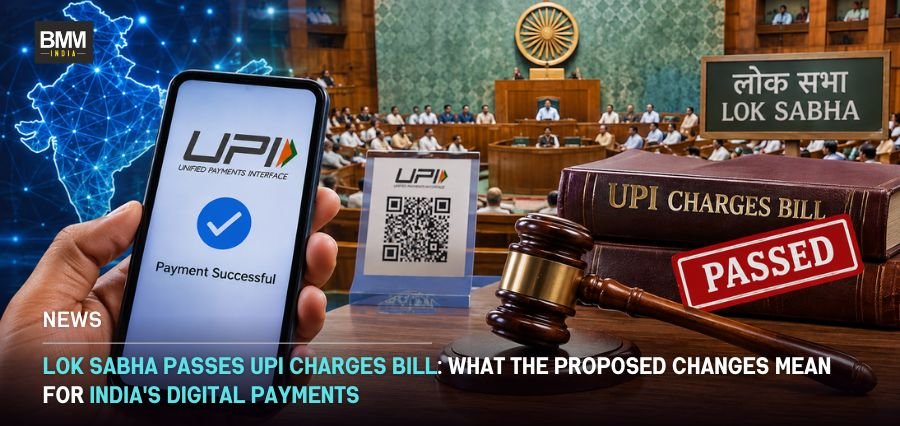

India’s digital payments ecosystem could be headed for a significant policy shift after the Lok Sabha passed amendments to the Payment and Settlement Systems Act, 2007, giving the Central Government the authority to permit banks and payment service providers to levy charges on Unified Payments Interface (UPI) transactions and other notified electronic payment modes. While the move does not immediately introduce charges, it creates a legal framework that allows the government to notify such fees in the future. The legislation is being viewed as an attempt to balance India’s rapidly expanding digital payment infrastructure with the financial sustainability of the institutions that operate it.
A Major Shift in India’s Digital Payment Policy
The UPI Charges Bill forms part of the broader Taxation and Other Laws (Amendment) Bill, 2026. The amendment replaces the existing legal restriction that prevented banks and payment system providers from imposing Merchant Discount Rate (MDR) on specified electronic payment methods, including UPI.
Until now, UPI transactions have largely remained free for merchants and consumers under government policy aimed at accelerating digital adoption. With the latest amendment, the government now has the legal authority to specify which electronic payment modes may attract charges through future notifications. Importantly, the UPI Charges Billitself does not impose any fees; it merely enables the government to do so if required.
Why the Government Introduced the Amendment
India has seen an explosion in digital payments in recent years, with UPI emerging as the favorite payment option for millions of users. Nevertheless, sustaining such a payment system entails massive investments in technology infrastructure, cybersecurity, fraud management, and network expansion.
The banks and payments processors have been complaining about the huge burden it puts on their pockets, as they process billions of payments in India without earning anything from it. According to the government, the amendment will enable them to develop a sustainable revenue model for payment infrastructure.
Will Consumers Have to Pay for UPI?
The biggest concern following the UPI Charges Bill passage has been whether everyday users will now be charged for making UPI payments.
According to the Finance Minister Nirmala Sitharaman, it does not necessarily follow that the consumers have to pay for transaction fees immediately due to the amendment. In the case where the MDR is adopted in future, it will mainly be applicable to the merchants and not the individual consumers. As of now, there has been no notification about MDR.
What Could Change for Businesses
In case the government at some point in time allows MDR on certain transactions, then companies that accept digital payments would have to pay processing fees depending on the transaction types that have been informed. Large retailers and businesses dealing in high-value digital transactions might face more impact than small businesses. Experts believe that the policymakers would continue safeguarding low-value transactions and smaller firms.
Industry Reaction and Future Outlook
The proposed amendment brings back into focus the decades-old question of whether India’s digital payments network should be subsidized. Payment companies and banks have repeatedly said that there is no way to sustain a zero-fee model with rising volumes of transactions. According to Reserve Bank of India’s Governor Sanjay Malhotra, it costs money to maintain the public payment system, which either needs to be paid by the taxpayers or by the user itself under MDR. However, policy makers take into account that any potential future modifications would not affect people’s use of digital payment systems
Conclusion
The passing of the UPI Charges Bill is significant legislation, yet it does not automatically affect the way Indians make use of UPI. It rather leaves the option open for the government to impose charges in the future by issuing notifications, depending on its assessment of what would be required for the sustainability of the system in the coming years. Consumers, meanwhile, can carry on with their usage of UPI in the same way as before.
Also Read : –Delimitation in India: The Political Storm Behind the Women’s Reservation Bill