
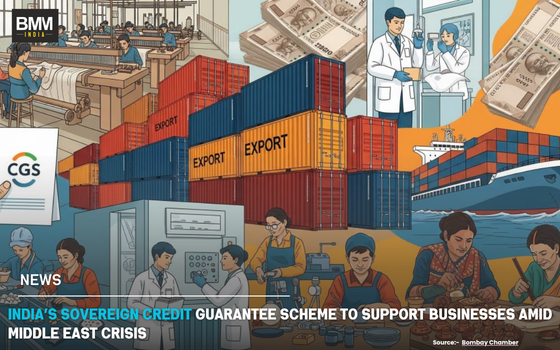
India is preparing to launch a major sovereign credit guarantee scheme to protect businesses impacted by the ongoing Middle East crisis. The move is expected to provide financial relief to small and medium enterprises (SMEs), especially sectors facing supply chain disruptions and rising operational costs. This sovereign credit guarantee scheme is being seen as a strategic economic response to geopolitical uncertainty.
Government’s ₹26.7 Billion Loan Support Plan
According to government sources, India plans to roll out sovereign credit guarantees on loans worth $26.7 billion. The scheme is designed to support businesses, particularly small firms, that have been severely affected by supply disruptions from the Middle East due to the ongoing U.S.-Israeli conflict with Iran.
The proposed sovereign credit guarantee scheme will reportedly remain in force for four years, offering banks stronger confidence to continue lending to affected businesses.
Who Will Benefit from the Scheme?
Some of the worst-affected industries include textile industries, glass manufacturing industries, and export-oriented companies. These enterprises are also dependent on imports of raw materials and trade routes with the Middle East.
The government can provide a 90% guarantee on loans of up to 1 billion rupees (about 10.75 million dollars) as per the plan. This implies that lenders will receive a significant portion of the loan sums in the event that a borrower defaults because of the crisis-related slowdown.
It is hoped that this sovereign credit guarantee scheme will benefit small businesses in the country, especially by keeping them afloat and operating amidst the prevailing economic uncertainty.
Estimated Cost to the Government
The approximate cost of the programme is 170 billion to 180 billion (approximately 1.83 billion to 1.94 billion) in terms of fiscal cost. Although the value is high, policymakers reckon that the economic rescue will circumvent a wider slowdown.
India is also experiencing the impact of rising oil prices, inflation, and low growth in its GDP because of the crisis in the Middle East, since it is the third-largest importer of oil.
Similar to the COVID 19 Credit Guarantee Model
This is not the first-time India has come up with such support measures. In 2020, the COVID-19 pandemic saw the government use a similar sovereign credit guarantee scheme to assist businesses, particularly the travel, tourism, and MSME sectors.
That plan assisted companies to resume operations, settle debts, and save jobs in one of the most difficult economic periods in the recent past.
The existing scheme is based on a similar structure, but it is made to respond to crisis-related disturbances caused by the conflict in the Middle East.
Economic Impact and Outlook
The sovereign credit guarantee scheme is believed to be important in ensuring the safety of the SME ecosystem in India. Small businesses are a great source of employment, exports, and manufacturing output.
The government is trying to ensure the banks by minimizing the risk so that the businesses will have a continuous supply of credit at a time when lenders might limit financing requirements.
The Reserve Bank of India has already provided repayment relief by extending the existing measure on export credit to June 2026 to take care of the exporters who are on the brink of repayment.
This sovereign credit guarantee scheme will serve as an economic safety net in the next few months to help businesses overcome inflation risks, supply disruptions, and global uncertainty.
Also Read :- RBI interest rate Hold Likely as Rupee Weakens and Bond Yields Rise