
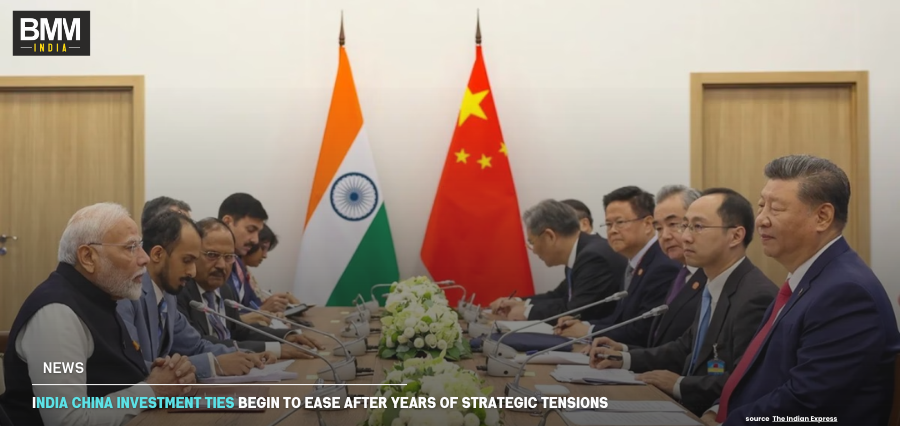
India has begun taking cautious steps toward rebuilding economic engagement with China after several years of strained relations. In early 2026, New Delhi approved easing restrictions on Chinese investments in selected sectors, signaling a gradual reset in India China investment ties that had been largely frozen since the deadly border clash in 2020.
The move reflects a shift in strategy by the government led by Narendra Modi, as economic priorities, supply chain demands, and diplomatic developments push both countries toward cautious cooperation.
Border Clash Triggered Restrictions on Investments
The major turning point in India China investment ties came in 2020 after violent clashes along the disputed Himalayan border. The confrontation significantly worsened relations between the two neighboring powers.
In April 2020, India introduced stricter scrutiny for investments from countries sharing a land border with India, including China. The government explained that the measure was designed to prevent opportunistic takeovers of Indian companies during the COVID 19 pandemic when businesses were financially vulnerable.
Two months later, India escalated its response by banning 59 Chinese mobile applications on national security grounds. Some of the most widely used apps included TikTok, WeChat, and UC Browser. The ban symbolized a broader freeze in India China investment ties as digital platforms and technology partnerships also came under scrutiny.
Chinese Investment Plans Faced Major Setbacks
Some of the huge Chinese investment plans were put in serious trouble after the new regulatory framework was implemented. Firms that were previously contemplating to make moves into Indian market had problems with approvals.
In 2022, Chinese car manufacturer Great Wall Motor had to drop its intentions of investing approximately one billion dollars in India, because it failed to find regulatory approval. This ruling was among the greatest setbacks in the Chinese investment ambitions in the country.
The other significant development was in July 2023 when Indian officials dismissed a billion dollar investment offer by Chinese electric vehicle producer BYD. Governments used the prevailing concerns of national security and it is an indication of how weak the India China investment ties were at the time.
Diplomatic Developments Open the Door for Cooperation
India and China started to talk about patrolling their disputed frontier, and signs of improvement began to show in October 2024. The realization assisted in calming tensions and ended a four-year military standoff along the border.
After this advancement in diplomatic relations, political leaders began to reevaluate the stringent rules in the screening of investments. In July 2025, the policy think tank of India, NITI Aayog, proposed to permit Chinese firms to purchase up to 24 percent of Indian firms without a comprehensive security clearance.
The offer was meant to cut the delays that the strict post 2020 approval system had caused and kill India China investment relations in a regulated way.
Renewed Political Engagement Between the Two Nations
There was also an increase in the diplomatic involvement between the two countries. Prime Minister Narendra Modi made his first such visit to China in over seven years in August 2025. The visit was highly viewed as a message that the two governments were ready to revive the dialogue and consider economic cooperation.
Further normalization occurred in October 2025 when the two countries decided to resume direct commercial flights after a five-year break. The reinstatement of air connections was deemed to facilitate business travel, tourism, and possible investment negotiations.
Later in December 2025, India also liberalized visa requirements for Chinese professionals. This relocation was aimed at resolving the challenge of insufficient supply of technicians and engineers in the Indian factories that had slowed down the production and resulted in massive wastage.
Gradual Easing of Trade and Equipment Restrictions
The latest action towards bettering India China investment ties was when India had started relaxing its control on the acquisition of Chinese equipment in February 2026. State managed power and coal companies had permission to make modest imports of Chinese equipment to counter the deficits and delays in the infrastructure projects.
Even though strategic prudence is still maintained, the change of policy is indicative of a pragmatic policy by New Delhi. Sectors, which are dependent on specialized machinery and parts, have been challenged by the issue of supply problems.
Though the state of the relationship between the two nations is complicated, a gradual loosening of investment and trade barriers implies that India China investment ties will gradually resume in the next few years as economical demands promote new cooperation.
Also Read :- IndiGo CEO Resignation: Leadership Shake-Up After Flight Cancellation Crisis