
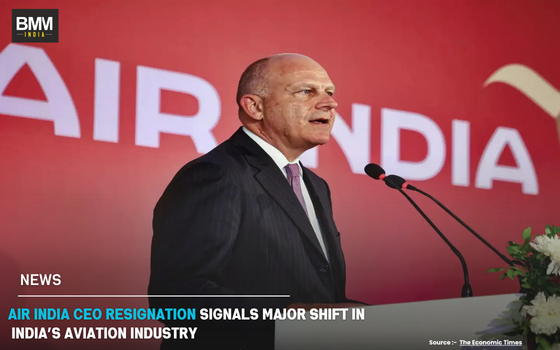
India’s aviation sector is witnessing a significant leadership shake-up as the Air India CEO resignation marks a crucial moment for the Tata Group-owned carrier. Campbell Wilson, who was brought in during 2022 to lead the airline’s transformation after privatization, has decided to step down, adding further uncertainty to an already challenging period for the industry.
The development comes at a time when India’s two largest airlines are facing mounting pressure from geopolitical tensions, operational hurdles, and rising competition.
Air India CEO Resignation: What Happened?
The Air India CEO resignation became official after the airline confirmed that Campbell Wilson had informed Chairman N. Chandrasekaran in 2024 about his intention to step down in 2026. According to the company’s statement, Wilson will continue in his role until a suitable successor is appointed.
Air India’s board has already constituted a committee to identify the next chief executive in the coming months. This transition is being closely watched, especially as the airline continues its ambitious turnaround journey under the Tata Group.
Wilson, a former Singapore Airlines executive, was appointed after years of decline under government ownership. His original tenure was expected to continue until 2027, making this Air India CEO resignation an important and somewhat unexpected development for the sector.
Challenges Behind the Leadership Exit
The resignation of Air India CEO is part of a long list of severe problems that the carrier has to deal with. The Middle East conflict has caused industry-wide disruptions that have contributed to uncertainty of routes and the cost of operations. Meanwhile, domestic factors like the lack of fleets, the delay of aircraft delivery, and post-COVID disruptions in supply chains have impacted the airline transformation plans.
N. Chandrasekaran recognised these external pressures, where there was a delay in the delivery of aircraft and retrofit programs.
During Wilson’s tenure, there was also a massive engineering overhaul and cabin refurbishment program. However, modernization was hampered by supply chain bottlenecks, and even the turnaround became more challenging than was first expected.
Campbell Wilson’s Legacy at Air India
In the country, the change in one of the most closely followed airlines since he assumed the leadership has been led by Wilson. Air India, under his leadership, concentrated on modernization of operations, aircraft interior refurbishment, and regaining customer confidence.
The Air India CEO resignation thus signals the conclusion of a turning point in the post-privatization life of the airline.
Aviation analyst Brendan Sobie has pointed out that Wilson worked in some very difficult conditions, and it will not be easy to locate a suitable successor.
This change in leadership is all the more crucial, with the newcomer leader, IndiGo, having just appointed an aviation veteran, Willie Walsh, as its new CEO, and this factor increases the intensity of competition in the market.
What This Means for Air India’s Future?
Air India CEO resignation leaves critical questions concerning the future of the airline in terms of growth. The choice of the successor of Wilson by the Tata Group may influence the future direction of the company, particularly in its internationalization and recovery in its operations.
The incoming CEO will have a complicated situation to deal with: increasing competition, geopolitical turmoil, and the necessity to finish the current transformation process.
As the aviation industry in India is growing at a very near rate, the leadership choices made at Air India is going to have an impact on the industry.
Also Read :-IndiGo CEO Resignation: Leadership Shake-Up After Flight Cancellation Crisis