
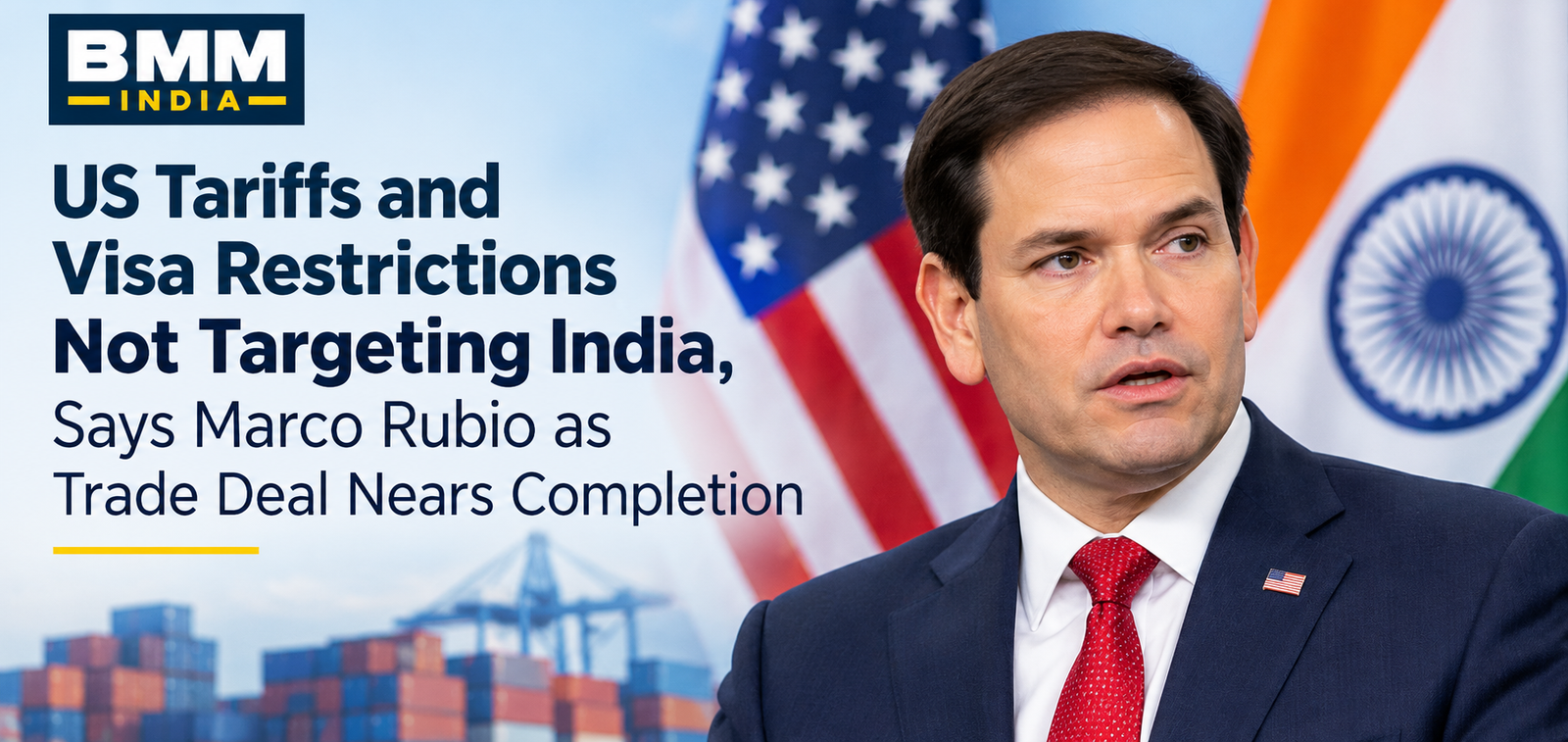
US Secretary of State Marco Rubio has sought to ease India’s concerns over Washington’s trade and immigration policies, insisting that the Trump administration’s measures are not specifically directed at New Delhi. During his official visit to India, Rubio said the two countries were close to finalising a long-pending trade agreement, with approximately 99% of the work completed. His remarks come amid growing concerns over American tariffs, tighter visa rules and the broader implications of US foreign policy for India’s economic and strategic interests.
Rubio Says Tariffs Are Not Intended to Harm India
Addressing concerns surrounding the US tariffs and visa restrictions, Rubio said the administration’s trade measures were part of a wider foreign policy strategy rather than an attempt to penalise India. He explained that Washington’s approach was linked partly to efforts to end the Russia-Ukraine war and apply economic pressure in response to the conflict.
Indeed, Rubio understood that such steps may affect bilateral economic ties and therefore needed to be well-managed. At the same time, he emphasized the recent decision by the US President Donald Trump to waive some Russia-specific tariffs, claiming that the administration clearly understood the potential harm from such steps to its relations with India.
In Rubio’s view, the preservation of relations with India was among the factors considered by the US policymakers. The problem illustrates the dilemma that the US is facing when trying to shape Russia’s behavior while keeping good relations with countries still purchasing Russian energy.
India-US Trade Deal Reportedly 99% Complete
According to Rubio, the ongoing negotiations had made some progress, and there was reason to believe that the deal would be concluded within several weeks instead of months, as both parties approached the end of an extensive negotiation process.
The outstanding issues reportedly related to the wording of particular provisions of the agreement, although Rubio did not specify what provisions those were. The issue was that both sides had to understand the meaning of the terms in order to avoid any further disputes regarding their interpretation.
The potential agreement is of importance for businesspeople and investors from both countries. Its successful conclusion could give clarity on trade terms and promote economic cooperation between the two countries.
At the same time, the deal has not yet been reached. As long as no agreement is signed, there will be uncertainty regarding trade terms and future economic relations between the two countries.
Visa Restrictions and Immigration Policy Under Scrutiny
The US tariffs and visa restrictions have raised fears among Indian students, skilled workers, and companies that require foreign talent.
With such close ties between the professional and educational institutions of India and the United States, any changes in the immigration policy of the US are going to have an effect on the Indian candidates.
According to Rubio, the visa policies of the US government were part of a global initiative towards reforming the US immigration system as opposed to being policies intended to harm Indians.
The government had attempted to rectify the weaknesses in immigration enforcement and ensure sustainability of the program. Despite this, it was clear that even though the policies might be seen as being specific to India from an Indian point of view, such issues existed in other countries too.
It remains to be seen how much relevance this clarification would have.
Balancing Strategic Interests and Economic Cooperation
In the context of the current row over the US tariffs and visa restrictions, one can see some difficulties in India-US relations. While both nations have made progress in terms of their joint work in such spheres as defense, technology, energy, and regional security, the disagreements over trade and immigration still exist.
The policy of Washington in regard to the Russian energy supply is also problematic for India. India has traditionally used crude oil imports for satisfying its needs in energy, and one of the countries supplying this fuel was Russia. As a result, the US pressure in regard to those who buy Russian energy creates additional problems for India.
This visit of Rubio and his talks with External Affairs Minister S. Jaishankar show the attempts to hold the dialogue despite all difficulties.
What Happens Next?
Rubio’s assurances suggest that Washington wants to prevent disagreements over the US tariffs and visa restrictions from damaging a strategically important relationship. The reported progress on the trade agreement offers a potential route towards reducing uncertainty, although the final outcome will depend on the resolution of remaining negotiating issues.
For India, the most pressing concerns are about getting predictable terms of trade, safeguarding opportunities for its professionals and students, and ensuring access to energy. The challenge for the US is to achieve its foreign policy goals without undermining any vital economic and strategic partnerships.
The next few weeks are going to be critical. Should India and the US succeed in forging the new trade deal that is under discussion, it will go some way towards restoring confidence and providing a more solid basis for cooperation between the two countries. Until then, assurances of Rubio can be reassuring but the effects of US policies will still matter.