
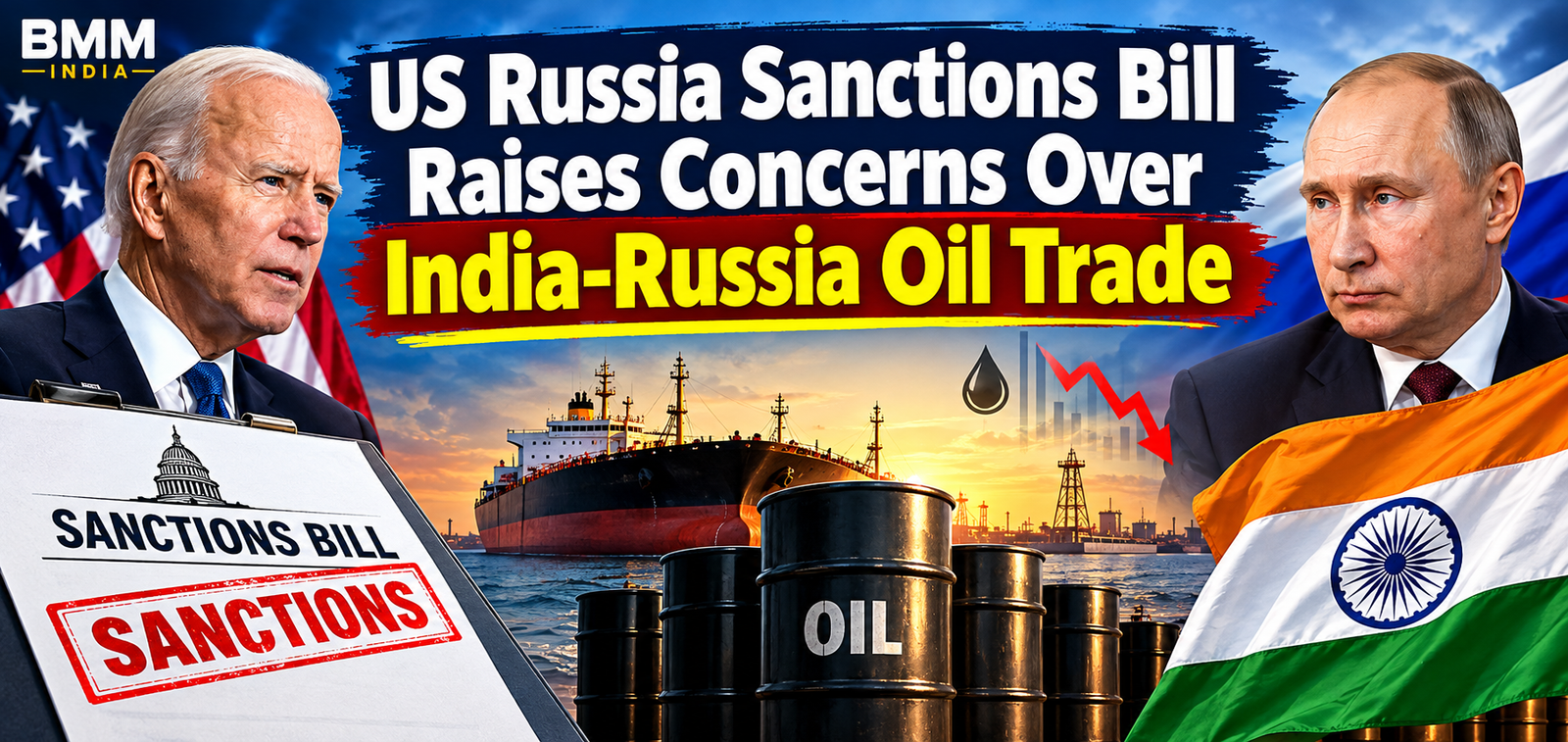
A major development in Washington has drawn global attention after the US House of Representatives advanced a sanctions bill that could allow tariffs of up to 100% on countries that continue purchasing significant volumes of Russian oil and natural gas. Among the nations potentially affected is India, one of the world’s largest energy consumers and a major buyer of Russian crude since the outbreak of the Ukraine conflict. The proposed legislation has placed the future of India-Russia oil trade under renewed international scrutiny.
The bill, known as the Lindsey O. Graham Sanctioning Russia and Iran Act of 2026, has already passed the US Senate and is now moving toward a final vote in the House. If approved and signed into law, it would grant the US President authority to impose tariffs on major importers of Russian energy.
What the Bill Proposes
The purpose of this piece of legislation is to exert economic pressure on Russia by focusing on the states that continue buying Russian oil and gas. Supporters of the bill say that revenues received from selling energy resources are used by Russia to finance its military activities in Ukraine. Thus, the proposed law attempts to stop mass buying of Russian energy due to heavy tariff sanctions.
As it is reported, some of the states that can come under the proposed tariff sanctions because of energy imports from Russia include India, China, Slovakia, Hungary, and Azerbaijan. The exact amount of the tariff will be decided by the US government.
Why India-Russia Oil Trade Matters
From 2022 onwards, there has been a noticeable increase in India-Russia oil trade. In view of the growing cost of energy globally and the necessity to ensure low-cost sources of energy, India began to purchase discounted crude oil from Russia. This move has ensured that India is able to deal with the inflationary pressures.
Energy security is of prime importance for India. India requires energy resources for which most of it needs to be sourced from abroad. As such, it has become necessary for India to source energy from low-cost sources. Russian crude has emerged as one of the vital sources of such energy for India.
Political Debate in the United States
However, there is no doubt that the move did not go unopposed. Whereas proponents consider the act as a necessity to apply more pressure on Russia, some of the opponents have voiced their fears about the wide range of powers to impose tariffs on behalf of the President of the United States.
The vote for the measure to pass through Congress was quite close in the House. This reflects the apprehensions felt by some legislators over the negative impact of such measures on the economy of the United States and its trading partners.
Potential Impact on Global Trade
These proposed tariffs might have more far-reaching consequences than those directly involved. Analysts point out that the markets for energy, the supply chain, and international relations regarding trade are highly intertwined. There is potential that any significant disruption of the India-Russia oil business may affect the price of energy, as well as overall trade negotiations.
This latest development is taking place against the backdrop of continued talks between India and the United States to enhance their economic ties. It can be assumed that both nations will try to balance their strategic interests despite their differences over energy and trade policies.
What Happens Next?
The proposed legislation is supposed to receive its last vote in the House of Representatives. In case it receives approval from there, the legislation will move through the legislative process, with the possibility of reaching the President’s office eventually. However, what must be noted is that this piece of legislation will give the mandate for tariff imposition, but does not necessarily mean that it will take place.
For now, governments, business communities, and energy markets around the world are looking at events happening in the US capital. The results of the voting process may affect not only US-Russia relations but also determine future direction of the India-Russia oil trade.
Conclusion
The passing of the Russia sanctions bill will certainly be an important event for international business and energy diplomacy. While the main intention of the bill is clearly to put pressure on Russia, it has resulted in broader talks regarding energy security and international economic policies. With the final vote drawing near, the fate of the India-Russia oil trade is an important concern for everyone.