
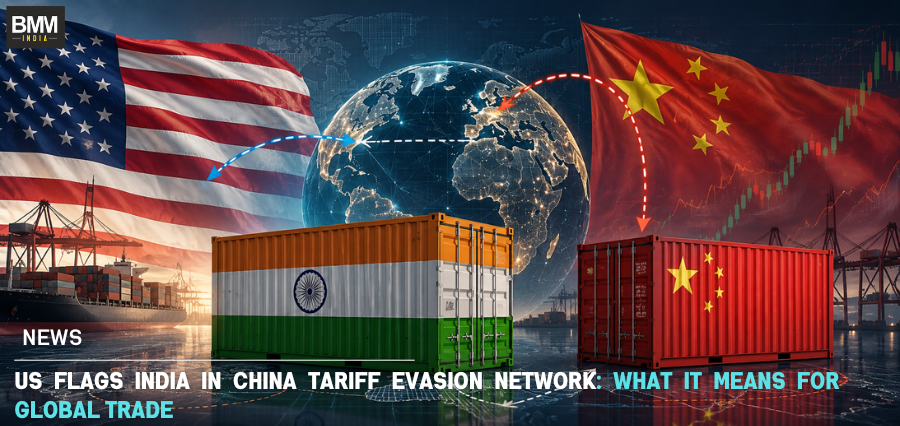
A fresh trade controversy has emerged after the United States identified India among more than 40 countries that it believes could be facilitating the movement of Chinese goods into the American market through indirect routes. The allegation is part of a broader White House initiative targeting what officials describe as a global China tariff evasion network, a system through which products originating in China are allegedly rerouted through third countries to avoid higher US tariffs.
The development comes at a sensitive time for global commerce, with supply chains already being reshaped by geopolitical tensions, tariff disputes, and efforts by multinational companies to diversify manufacturing bases away from China.
Why the US Is Raising Concerns
As per a recent report from the Office of Trade and Manufacturing Policy at the White House, Chinese export businesses have turned more towards transshipment methods after the introduction of the first round of US tariffs against Beijing in 2018. Transshipment refers to shipping goods via other countries before entering the United States, which makes it hard to identify the exact country of shipment.
The US trade advisor Peter Navarro said that this practice constitutes a big business that has developed into an extremely sophisticated worldwide model. As per the report, the China tariff evasion network may result in the loss of billions of dollars in tariffs and this has compelled Washington to step up its enforcement process.
The US says that the purpose is not only to confront China but also to examine countries which are facilitating such trade operations, whether on purpose or unintentionally.
India Categorized as a High-Risk Hub
India has been classified by the report as falling under the highest-risk category, along with a number of other economies and trading nations of the United States. The government officials stated that nations with a considerable manufacturing industry and strong trade connections are likely to become suitable transit destinations for products trying to find another way into the US.
According to the White House report, India, Mexico, and Vietnam have emerged as some of the top locations for products coming from China during the year 2025. According to the report, it was estimated that products worth tens of billions of dollars could have been transported through these channels.
While the report does not accuse India of officially endorsing such practices, its inclusion in the alleged China tariff evasion network has drawn attention because of India’s growing role in global manufacturing and its expanding trade relationsahip with the United States.
AI at the Center of Enforcement
Perhaps one of the most prominent features of the US strategy is the use of artificial intelligence. Washington intends to use a system known as “Detective Border” which uses artificial intelligence to analyze the information of the global trade and to look for any irregularities in the origins of the shipments, their route, and their composition.
The use of artificial intelligence is expected to help detect things that are hard to detect by regular inspection of customs. It could be considered as part of the efforts of using technology for the sake of improving trade enforcement and customs monitoring.
It would mean that the documentation and the origin verification would become harder for the companies working in international supply chain management.
Potential Impact on India-US Trade Relations
The controversy emerges as India and the US step up their economic engagement with each other. But being connected with the China tariff evasion system will make trade negotiations even more difficult and present new compliance issues to exporters.
Manufacturers in India who manufacture products in India could find themselves under even closer scrutiny by US customs, possibly requiring increased documentation, inspections, and delays. Analysts say those companies working in industries like electronics, machinery, and industry could especially feel the impact if enforcement actions increase.
On the other hand, India’s importance as an important manufacturing base makes it a key player for international companies looking to move away from China.
The Bigger Picture
The debate on the China tariff evasion network brings up the question of change in the structure of international business. Tariffs and other strategic restrictions put by the government make companies change their supply chain structure. It became extremely difficult to identify actual production from tariff evasion.
For India, the problem is going to be to keep the country’s image of an honest producer of goods while following all trade regulations. For the US, the problem is to implement their tariff policy and not disturb the global trade processes.
With the development of monitoring technologies and implementation of tougher trade regulations, the discussion on the China tariff evasion network is sure to remain relevant for months to come.