
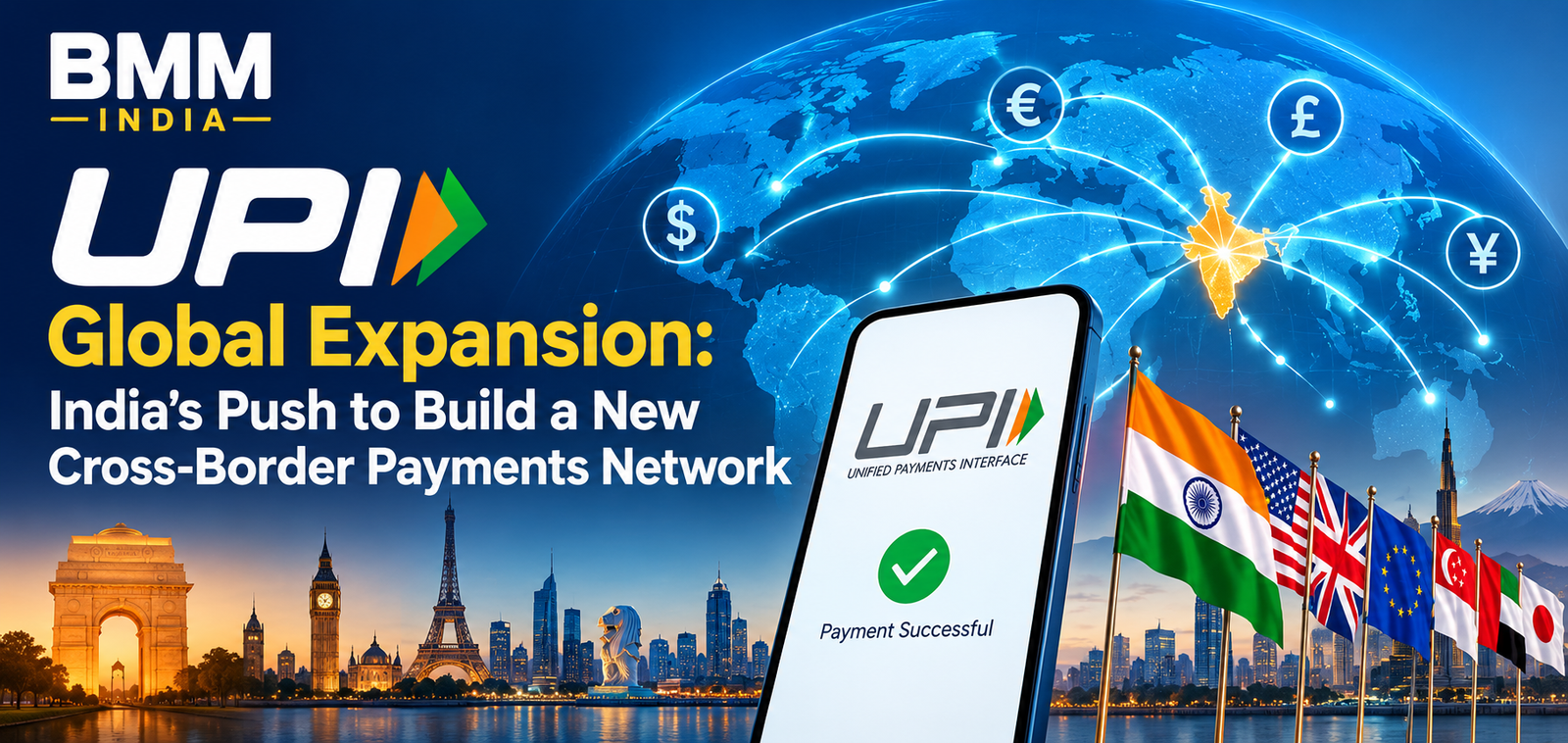
India is preparing to take its digital payments revolution beyond its borders. At the Global Fintech Fest 2026 in Mumbai, Prime Minister Narendra Modi called for deeper integration of India’s Unified Payments Interface (UPI) with international financial systems, particularly in countries with large Indian diaspora communities and strong trade relationships with India. The vision marks a significant step in the next phase of UPI Global Expansion, positioning India not just as a user of digital payment technologies but as a creator of global financial standards.
A New Vision for Global Payments
UPI has been revolutionizing Indian transactions for almost a decade now through the medium of instant digital payments for the masses. However, now, the government wants to replicate such ease beyond borders as well.
Prime Minister Modi highlighted at the conference that India should develop its own protocols for cross-border payments instead of just using the payment architecture of foreign nations. The idea is to create links between the UPI system and other payment systems around the world.
The UPI Global Expansion drive indicates the growing confidence of India in its digital ecosystem and in its desire to become a strong player in the international fintech ecosystem.
Reducing the Cost of Remittances
One of the strongest arguments behind UPI Global Expansion is the potential to lower remittance costs.
India continues to be the largest country in terms of foreign currency remittance transactions, and receives billions of dollars annually from their citizens living outside of India. Normal international fund transfer processes include high costs and long processing times for transactions. “UPI’s ability to connect to foreign payments systems can help transfer cash into India at lower costs and faster,” said Modi.
This will be especially beneficial to the millions of Indians living in the Middle East, North America, Europe, and Southeast Asia.
Singapore as the Model
India has an excellent example of cross-border digital transactions via UPI connectivity in Singapore’s payment system.
The Prime Minister mentioned the ease of transactions taking place between India and Singapore in a way that is convenient as much as internal transactions. Such success is being followed by India for its future alliances with other nations.
It is expected that extending such alliances to other nations will boost UPI Global Expansion.
Strategic Importance Ahead of BRICS Summit
This move is being made amid a period in which digital finance has come to gain prominence in discussions among developing nations.
As the BRICS Summit approaches, there are talks among the member nations about finding a way of facilitating trade settlement and payment interoperability through local currency and fast payment channels. This can be facilitated by interlinking the UPI with other fast payment channels abroad.
As UPI Global Expansion gains momentum, India could play a leading role in shaping the future architecture of digital payments across developing economies.
More Than Just Payments
Moreover, the Prime Minister stated that innovations in fintech must go beyond basic payment processes.
The Prime Minister encouraged the industry to branch out into other aspects like credit, insurance, savings, investment, and pension products. This wider scope indicates that the development of the UPI Global Expansion would open up various possibilities for both consumers and organizations in the future.
Also, there have been some developments in AI-based payment processing systems and automated transaction systems that show that India’s fintech community is gearing up for the future of digital commerce.
The Road Ahead
UPI is already operational in several international markets and keeps expanding into new regions. In line with rising interest in real-time digital payments, the payment infrastructure of India is beginning to be considered a case study for financial inclusion and innovation.
For UPI Global Expansion to become successful, it is going to need collaboration in terms of regulation, cybersecurity policies, and partnership building in relation to foreign financial systems. However, the goal is clear, India is no longer concerned only about the digitization of domestic payments but also seeks integration of its homegrown fintech solutions into the world.
In case of success, UPI Global Expansion will change the way cross-border transactions work and make India a leader in the realm of fintech.