
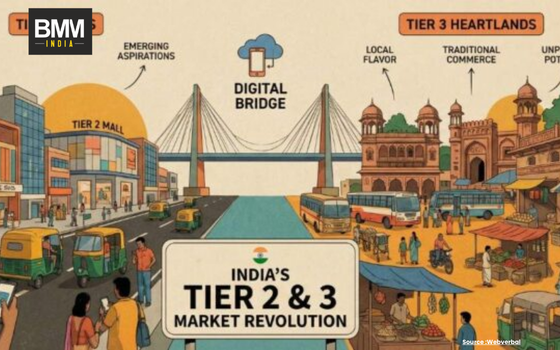
India’s entrepreneurial map is being redrawn. For years, startup energy was concentrated in Bengaluru, Mumbai, and Delhi NCR. Today, however, Tier-2 & Tier-3 Cities Startups India is emerging as a defining growth story. Smaller cities are no longer peripheral players. They are becoming powerful innovation hubs, attracting founders, investors, and talent at an accelerating pace.
This change in structure is a sign of bigger changes in the economy and technology. Tier-2 and Tier-3 cities in India are becoming serious players in the startup scene thanks to cheap internet, better infrastructure, government support, and rising local hopes.
Why Tier-2 & Tier-3 Cities Startups India Is Gaining Momentum?
The rise of Tier-2 & Tier-3 Cities Startups India is not accidental. It is rooted in changing economics and access.
First, the cost of doing business in cities like Indore, Jaipur, Coimbatore, and Lucknow is much lower than in Bengaluru or Mumbai. Office rent, employee pay, and living costs are all more sustainable, which gives startups more time to grow and run their businesses well.
Second, digital penetration has made it easier for people to connect across borders. Entrepreneurs can now build and grow products from almost anywhere thanks to cheap smartphones and fast internet. Customers don’t care where a company is based anymore as long as the product is useful.
Third, the local markets in these cities are also growing. As disposable incomes and spending habits rise, there is a need for fintech, edtech, healthtech, and e-commerce solutions that are specific to each region.
Government Push and Policy Tailwinds
Policy initiatives have further accelerated Tier-2 & Tier-3 Cities Startups India. The Startup India program has encouraged entrepreneurship beyond metropolitan centers. State governments are also launching incubation hubs, innovation labs, and funding schemes to nurture local founders.
Startup summits, hackathons, and accelerator programs that are just as good as those in bigger cities are now held in cities like Indore and Jaipur. University ecosystems are becoming more business-friendly, which makes students want to start their own businesses instead of moving to get corporate jobs.
This decentralized policy push is helping to spread opportunity more evenly across the country.
Talent Retention and Reverse Migration
One of the most important drivers of Tier-2 & Tier-3 Cities Startups India is talent retention. Earlier, ambitious professionals migrated to metropolitan hubs for better career prospects. Today, many are choosing to stay or return home.
The pandemic sped up the rise of remote work culture, which made distributed teams more common. Engineers, designers, and marketers with skills can now work on global projects without moving. This has made it possible for startups in smaller cities to find good workers without having to pay higher salaries in big cities.
Reverse migration has also been a factor. During lockdowns, professionals who went back to their hometowns found that building businesses there was possible. People have been drawn to lower living costs and the fact that they are familiar with the area.
Sector Specific Growth in Smaller Cities
Tier-2 & Tier-3 Cities Startups India is particularly strong in sectors aligned with local strengths.
Cities with agricultural belts are good places for agri tech startups to grow. Healthtech platforms are filling in the gaps in healthcare access in some areas. Edtech companies are going after students who live outside of cities and want resources to help them prepare for competitive exams and improve their skills.
Fintech is another big factor in growth. Startups are making things for small businesses, micro entrepreneurs, and people who are using digital banking for the first time in semi-urban and rural areas.
These businesses solve real, local problems, unlike metro-focused startups that often go after high-end urban markets. Being close to end users gives them a better understanding and lets them make changes more quickly.
Investor Attention Shifts Beyond Metros
Venture capital is beginning to follow this momentum. While Bengaluru remains India’s startup capital, investors are increasingly scouting Tier-2 & Tier-3 Cities Startups India for untapped potential.
These markets are appealing because they have lower valuations, strong founder commitment, and access to new consumer bases. Angel networks and regional venture funds are growing, and they give local entrepreneurs money to start their businesses.
Digital demo days and virtual pitching have made it less necessary for founders to move to raise money. Geography is becoming less of a problem when it comes to investing.
Infrastructure and Ecosystem Development
The ecosystem around Tier-2 & Tier-3 Cities Startups India is also developing. Co working spaces, incubators, mentorship networks and local angel communities are becoming a steadily growing phenomenon.
Such cities as Coimbatore have established robust hardware and manufacturing startups networks. Jaipur is creating a vibrant city of artists and technocrats. Indore is a city that has a clean government and well-organized support to new businesses.
Such ecosystems are not as thick as Bengaluru is, but no less substantial since they are flexible and collaborate closely.
Challenges on the Growth Path
There are problems with Tier-2 & Tier-3 Cities Startups India although it is promising. Availability of late-stage capital continues to be concentrated in big metros. Talent pools in such areas as advanced AI or deep tech might remain small.
Small cities can also make it more difficult to be heard by your brand, particularly when the business is facing global competition. However, these boundaries are gradually disappearing as all people can easily see things thanks to the rising influence of digital media.
There are also regions that require assistance with their infrastructure, particularly in matters of the logistics and high-tech research infrastructure.
The Future of Tier-2 & Tier-3 Cities Startups India
The next decade could redefine India’s entrepreneurial geography. Tier-2 & Tier-3 Cities Startups India represents not just expansion but redistribution of opportunity.
As digital connections get stronger and local ecosystems get stronger, smaller cities are likely to make unicorns and category leaders. More importantly, they will create jobs, keep skilled workers, and promote balanced economic growth.
There are now more than a few pin codes in India that tell the story of its startups. It is happening in dozens of new urban centers, each of which is making its own unique contribution to growth and innovation.
Tier-2 & Tier-3 Cities Startups India is not a temporary shift. It is a structural transformation that signals the broadening of India’s entrepreneurial base and the rise of a more geographically inclusive innovation economy.
Also Read : Business Minds Media India For more information