
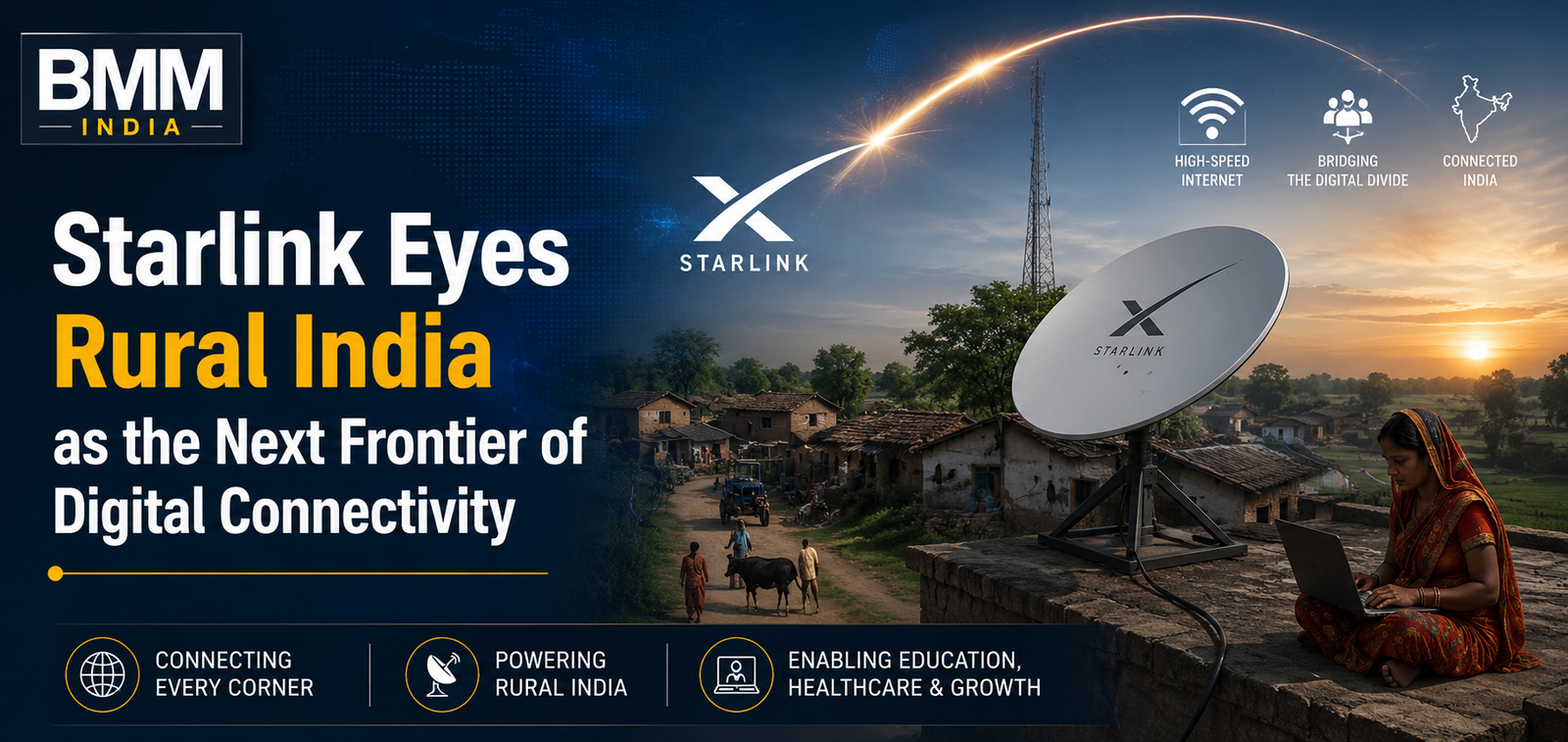
India’s digital transformation has been one of the most remarkable stories of the past decade. From widespread smartphone adoption to rapid expansion of 4G and 5G networks, millions of people have gained access to online services, digital payments, education platforms, and e-governance initiatives. Yet despite this progress, significant connectivity gaps remain, particularly in remote and rural regions.
This challenge has once again come into focus after Elon Musk stated that Starlink could help the “least served” communities in India, especially those living in rural areas. His remarks have renewed discussions about the role satellite internet could play in expanding access to high-speed connectivity across the country.
Elon Musk’s Vision for Rural India
Elon Musk recently highlighted Starlink’s potential to serve areas where traditional internet infrastructure remains limited. According to Musk, the satellite internet service can be particularly beneficial for rural and underserved regions that continue to struggle with reliable broadband access.
His comments come at a time when India is intensifying efforts to bridge the digital divide and ensure that every citizen has access to affordable internet services. The discussion around Starlink Rural Connectivity reflects a broader goal of ensuring that geography no longer determines access to information, education, healthcare, and economic opportunities.
Unlike conventional broadband networks that depend on extensive ground infrastructure, Starlink uses a constellation of low Earth orbit satellites to provide internet coverage across vast geographical areas. This makes it particularly attractive for locations where laying fibre optic cables or expanding mobile towers is difficult or economically unviable.
Why Rural Connectivity Remains a Challenge
Despite the huge advancement made by India in terms of telecommunications infrastructure, there remain many areas of the country facing connectivity issues. Connectivity issues are common in mountainous regions, forests, border regions, and villages that do not have enough population density.
Recent reports have indicated that several thousand villages in India are yet to receive proper mobile network connectivity.
It is here that the relevance of the service known as Starlink Rural Connectivity can be observed, because satellite internet does not need as much ground infrastructure as conventional broadband internet requires.
The improved connectivity can help in education, telemedicine, digital banking, agricultural advice, and e-commerce opportunities for rural citizens.
Starlink’s Growing Interest in India
The Starlink project has been making efforts to penetrate the Indian market for some time now. It has been observed that Starlink is applying for regulatory approvals once again while trying to set up its satellite broadband services in India.
It is not surprising why Starlink would show interest in the Indian market. With over 1.4 billion people and a large amount of untapped market potential in its rural areas, India is one of the largest markets of the world for satellite broadband services.
Starlink Rural Connectivity project also fits well with the overall digital inclusion strategy of India. There have been many instances when different state governments in India tried to partner in order to bring satellite internet to their rural and unserved areas. For instance, the government of Gujarat recently entered into an agreement with Starlink through a Letter of Intent in order to improve connectivity in their unserved areas.
Opportunities for Education, Healthcare, and Business
The benefits of Starlink Rural Connectivity extend beyond simply providing internet access.
Education
Students who reside in rural areas have difficulty accessing digital content and learning material. Improved internet access will allow students to participate in virtual classes and access different education platforms.
Healthcare
Telemedicine has proved to be one of the effective tools for increasing access to healthcare. Good connectivity will allow villagers to consult doctors and avail healthcare services through digital channels.
Agriculture
Farmers have become dependent on weather information, market-related information, and other advisory services which can only be accessed using satellite internet.
Small Businesses
Businessmen in rural areas can have access to e-commerce portals, payment platforms, and other marketplaces.
Challenges Ahead
Though prospects are encouraging, there are still quite a few hurdles in front of Starlink Rural Connectivity becoming a reality in India.
Regulatory clearance, spectrum allocation, security aspects, pricing models, and infrastructure deployment are all factors that need to be considered carefully.
Price may also be an important aspect. As industry insiders have already observed, the cost of satellite internet services needs to be appropriate for them to gain mass appeal in the rural and less affluent sections of society.
India’s fast-growing mobile broadband networks are bound to play their part in determining the competitive positioning of satellite internet services.
The Road Ahead
The technological future of India would entail the use of a number of technological solutions as opposed to just one technology. The fiber optic networks, mobile broadband, 5G services, and satellite internet all have distinct strengths and weaknesses.
Given the changing dynamics, Starlink Rural Connectivity could become a vital addition to the already existing connectivity infrastructure in areas where conventional solutions face geographical and financial challenges.
The recent words of Elon Musk reveal that there is a developing consensus that satellite broadband is capable of playing a role in connecting unconnected communities.
While the future remains to be seen as far as the regulatory and implementation procedures go, the next few years will show whether the satellite connectivity offered by Starlink is capable of filling the remaining digital gap in India.