
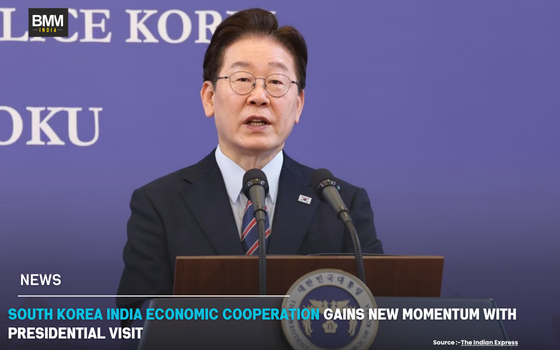
South Korean President Lee Jae-myung arrived in New Delhi on Monday for high-level talks with Indian Prime Minister Narendra Modi, marking the first South Korean presidential state visit to India in eight years. The visit highlights the growing importance of South Korea India economic cooperation as both nations aim to strengthen trade, investment, and strategic partnerships in a rapidly changing global economy.
President Lee emphasized the need to transform bilateral relations, stating that the current level of economic cooperation between South Korea and India remains below its true potential. Speaking during a dinner meeting with members of the Korean community in New Delhi, he said both countries must work together to create a stronger and more dynamic economic future.
Focus on Trade Expansion and CEPA Upgrade
A major agenda item during the visit is the improvement of the Comprehensive Economic Partnership Agreement (CEPA) between the two nations. Officials from both countries are working toward nearly doubling bilateral trade to $50 billion by 2030, compared to $25.7 billion recorded last year.
Presidential adviser Wi Sung-lac explained that expanding trade relations is central to the future of South Korea India economic cooperation. The revised agreement is expected to reduce trade barriers, improve market access, and encourage stronger business partnerships across key industries.
India and South Korea have maintained strong commercial ties for years, but both sides now want deeper engagement that moves beyond traditional trade and enters strategic long-term cooperation.
Shipbuilding, AI, and Defence Take Center Stage
Shipbuilding is one of the most significant industries that were covered during the visit. South Korea is known to the world as an advanced shipbuilding industry and India is also concentrating on the development of the maritime infrastructure and its industries. This is a big opportunity towards mutual growth in both countries.
Other than shipbuilding, there are also talks in the area of artificial intelligence, finance and cooperation in defence. These areas are the future of South Korea India economic cooperation, mainly as the two nations are to take a more dominant place in international technology and security networks.
It is also anticipated that President Lee will be involved in key business meetings with business leaders of the two countries, who will assist in establishing new investment avenues and business alliances.
India’s Role in Supply Chain Security
President Lee also pointed out the strategic significance of India that has been enhanced by global instability, particularly, tensions that are associated with the Iran conflict. India is no longer being considered as a consumer market, but as an important part of global production and supply chains, he said.
This point of view has enhanced South Korea India economic collaboration and especially energy security. South Korea had called on India last month in urgent plea to increase the supply of naphtha to mitigate any disruptions that could happen due to Middle East tensions.
India is today one of the key suppliers of naphtha to South Korea, supplying nearly 8 percent of the total naphtha imports of South Korea in volatile international circumstances. This action indicates the now strong association of economic alliances with geopolitical stability.
Addressing Trade Imbalance Concerns
Lack of balance in trade is one of the greatest concerns in bilateral relations. South Korea had a trade surplus of 12.8 billion last year with exports of 19.2 billion to India and imports of 6.4 billion.
According to Yeo Han-koo, the South Korean Trade Minister, there should be more imports into the country to address this imbalance and establish healthier trade relations. The issue of growing deficit has long been a concern of Indian policymakers, and they consider this to be a problem requiring immediate policy intervention.
Analysts in Seoul have also noted that as the relationship between the two has increased steadily in terms of commercial relationships, the political relationship has not been increasing at the same pace. To be successful in the long term, it will be necessary to strengthen diplomatic trust.
A Strategic Partnership for the Future
The recent trip by President Lee is an indication of a significant shift in South Korea India economic cooperation. Both nations are not only pursuing trade development, but an even bigger strategic alliance that is founded on trust, technology and mutual economic objectives.
With world supply chains moving and geopolitical tensions growing, India and South Korea are discovering greater incentives to cooperate. From shipbuilding to energy security and high technology, this partnership can reshape the Asian economic landscape over the next few years.
Having both Prime Minister Modi and President Lee on strong leadership, the future of bilateral cooperation is now much brighter than it ever was.
Also Read :- India Gets Relief as Iran Denies Charging Hormuz Transit Tolls