
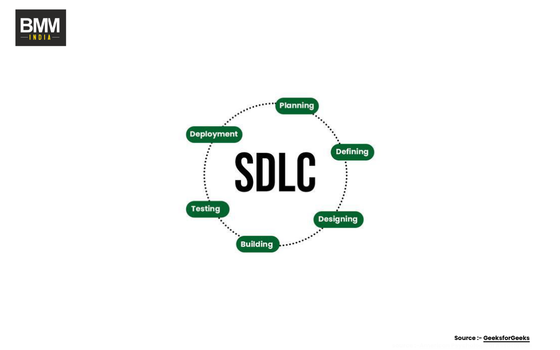
In the modern digital era, the software development life cycle is essential for the success of all apps, websites and enterprise software platforms. Whether you are a small start-up or working in a major IT organisation, software processes are used to develop robust and scalable systems. The software development life cycle allows developers to plan their work, minimise mistakes and enhance the user experience. In a country like India, where the IT industry is growing by leaps and bounds, this process is crucial for businesses to remain competitive and build robust software products.
What Is Software Development Life Cycle and Why It Matters
The software development life cycle (SDLC) is a systematic approach that software developers take to build, test, and maintain software products. It offers a framework that allows teams to plan and control the development process.
It helps to ensure that software is developed to meet business, customer, and technical requirements. Rather than hasty development, businesses apply the software development life cycle to minimise risk, enhance teamwork, and ensure quality throughout the process.
In India, with the growing pace of digital transformation in businesses, the software development life cycle is increasingly becoming important in banking, healthcare, education, e-commerce, and manufacturing sectors.
The Stages in the Software Development Life Cycle
Each phase of the software development cycle is crucial in developing robust software solutions. Each phase must be given attention to ensure project success.
1. Requirement Analysis
The initial phase is to understand the business requirements and project objectives. This involves collaboration between software developers, stakeholders, and customers to define the purpose of the software, target users, and required functionality.
A good analysis of requirements avoids ambiguity and stops development from going wrong.
2. Planning and Design
The next step is planning and design. Developers develop project schedules, budgets, resources, system architecture, and technology platforms. Software designers also develop the blueprint for the software, including the user interface and database design.
This sets the stage for the successful execution of the project.
3. Development and Coding
Here, the programmers start coding based on the accepted designs and plans. This is where concepts are turned into code using programming languages, tools and testing methodologies.
Sound development increases performance, security and scalability.
4. Testing and Quality Assurance
Before release, the application should be tested for any bugs, poor performance, and vulnerabilities from the security perspective. Quality assurance ensures that the application works perfectly across various platforms and usage situations.
Testing is an essential component in the process of software development, since it helps to assure the satisfaction of users and protect the reputation of the brand.
5. Software Deployment and Maintenance
After testing, the software is deployed and can start operating. However, maintenance should not be neglected at all.
Maintenance will ensure long-term success.
Benefits of Software Development Life Cycle in India
The software development life cycle is a great benefit to Indian companies, particularly as India becomes an increasingly important IT outsourcing destination.
Improved project management is a key advantage. Indian IT firms play a crucial role in large domestic and global projects and having a structured development process helps keep time, money and client satisfaction on track.
A big benefit is cost effectiveness. Early risk detection and minimisation of rework help save time and money. This is particularly advantageous for small and new businesses.
It also enhances quality. Following a software development cycle means more testing, security and user satisfaction, enabling businesses to gain greater credibility in the market.
It also helps with documentation and compliance, which is necessary in industries such as banking, finance, healthcare and government projects that require compliance with specific standards.
Popular Models Used in Software Development Life Cycle
Different businesses use different models depending on project size, goals, and flexibility requirements.
1. Waterfall Model
The Waterfall model follows a fixed sequence where each stage must be completed before moving to the next. It works well for projects with clear and stable requirements.
2. Agile Model
The Agile model is very adaptable and emphasises incremental development. This is popular in India due to the rapid delivery and flexibility to respond to customer requirements.
3. Spiral Model
In the Spiral model, planning, design and testing are done in iterations. It’s typically used for high-risk projects requiring frequent reevaluation.
Using the right model allows firms to become more efficient and lessen the development difficulties.
Future in India
Since India continues to be a significant contributor to the IT service industry, the prospects for the software development lifecycle in India are indeed bright. Some of the technologies driving software development and maintenance include artificial intelligence, cloud computing, cybersecurity, and automation.
Businesses are also adopting approaches such as DevOps and continuous integration that ensure faster and more efficient development processes.
This new approach makes software development lifecycle rapid, effective and inclusive. With the dawn of the digital age, there will be a growing demand for individuals who understand the software development lifecycle.
Conclusion
The software development life cycle is the process that underpins software development. It offers a clear journey from conception to maintenance, enabling companies to produce secure, scalable and robust software.
In a country like India, where technology is a catalyst for economic development and innovation, knowledge of software development life cycle is essential. It not only enhances project delivery but also gives businesses a competitive edge in our rapidly evolving digital era.
Also Read :- Why Product Lifecycle Management Is Essential for Business Growth in India?