
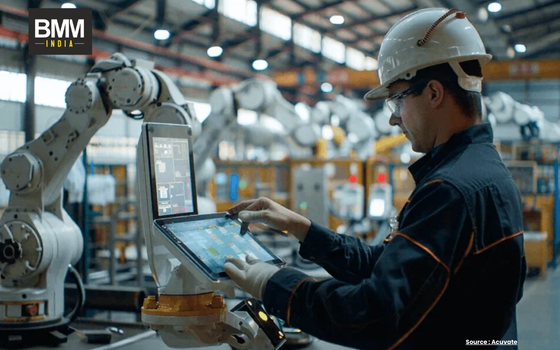
India is witnessing a technological transformation that is reshaping the foundations of its traditional industries. For decades, sectors such as manufacturing, agriculture, logistics, and healthcare relied heavily on manual processes and conventional management systems. Today, the integration of advanced technologies such as artificial intelligence, the Internet of Things (IoT), and automation is changing how businesses operate and compete. Smart India is no longer just a vision; it is becoming a practical reality as digital innovation modernizes industries that form the backbone of the country’s economy.
The increased access to data, low-cost digital infrastructure, and government favouring innovation are driving this change faster. The solutions that are technologically made are helping companies to be more efficient, achieve cost savings and make wise decisions based on data analysis. With these new technologies taken up by businesses, the old sectors are turning into more intelligent, more interconnected systems able to work to address the needs of the fast-evolving economic system.
Smart India: The Rise of Intelligent Technologies in Industry
Smart India is an idea that represents a more global transition to technologies. The introduction of artificial intelligence, IoT devices, and automated systems is being revealed in the daily processes in the areas that previously relied mostly on human resources and classic equipment.
Artificial intelligence enables businesses to process large amounts of data and detect trends that can be used to make strategic decisions. The IoT devices unite machines, sensors, and systems with digital networks, which facilitate real-time monitoring and control. Robotic systems facilitate the process of automating monotonous functions, which enhances productivity and uniformity in work.
The Tata Consultancy Services and Infosys technology companies are also playing a significant role in assisting industries to embrace digital solutions. These companies offer high-end software solutions, data analytics applications, and automation tools that help companies to modernize their businesses.
Artificial Intelligence in Manufacturing and Production
Artificial intelligence is becoming a powerful tool in India’s manufacturing sector. Traditionally, factories relied heavily on manual inspection and reactive maintenance. Today, AI-powered systems are helping companies predict equipment failures, optimize production schedules, and enhance quality control.
Through machine learning algorithms, manufacturers can analyze operational data from machinery and production lines. This allows businesses to detect anomalies early and schedule maintenance before problems escalate. Predictive maintenance reduces downtime and improves overall efficiency.
AI is also enabling smarter supply chain management. By analyzing demand patterns and inventory data, companies can forecast production needs more accurately and reduce waste. These capabilities allow manufacturers to remain competitive in both domestic and international markets.
The Role of IoT in Connected Industries
Another significant driver of the revolution in the traditional Indian industries is the Internet of Things. IoT technology links physical devices, including sensors, machines, and vehicles, to digital platforms, which enables a business to monitor operations in real-time.
In the field of agriculture, IoT sensors are assisting farmers to monitor the soil conditions and weather patterns and monitor the health of crops. The insights can be used to carry out irrigation, fertilizer application, and pest control more efficiently. Consequently, farmers are able to increase crop production and minimise the use of resources.
IoT is used in logistics and transportation to track shipments, monitor the performance of vehicles, and optimize delivery routes. This visibility assists businesses in minimizing delays, saving fuel, and enhancing efficiency within the supply chain.
Governmental projects like Digital India are helping to move to the world of connected technologies by increasing the digital infrastructure and promoting innovation in all industries.
Automation Reshaping Operational Efficiency
Automation is increasingly becoming relevant in enhancing the productivity of the industries in India. Monotonous manual labor is being eliminated with automated machines, robots, and workflows powered by software instead of human labor.
Products in manufacturing plants are assembled by robotic arms, which are very fast and precise. Packaging machines guarantee a uniform product quality and a higher output rate. These technologies do not only enhance the capacity of production, but also minimize operational errors.
Service-based industries are also being changed through automation. As an illustration, the routine questions and transactions can be managed using automated customer service systems, so that the human employees can be engaged in more demanding activities. This change helps the businesses enhance the efficiency of the services and also control the operating costs.
Smart Infrastructure and Urban Development
It is not just individual industries that are undergoing transformation to Smart India. Even the infrastructure of the cities is changing through the incorporation of technology-based systems. Connected solutions to transportation, management of energy, and public services are being unveiled in smart city projects in the country.
As an example, real-time data analytics based on the traffic management systems will decrease congestion and enhance road safety. Smart grids will assist in monitoring power consumption, as well as aid in the distribution of power that is more efficient. Such projects show how technology can help to improve the operations of the entire urban ecosystem.
Companies like NITI Aayog are trying to foster innovation and the usage of emerging technologies in various industries.
Challenges in the Transition to Smart Industries
Even though progress has been achieved, transitioning to Smart India has a number of challenges. Lack of technological skills, high costs of implementation, and cybersecurity are some of the barriers that many conventional businesses continue to experience.
Another matter is workforce readiness. With the increasing prevalence of automation and digital systems, employees have to acquire new skills to work with the advanced system. The educational programs and training will be necessary to make sure that the workers can adjust to these evolving requirements of the industry.
Data security and privacy are also important factors. Since more and more industries use connected and digital systems, it becomes even more important to protect sensitive information.
The Future of Smart India
The process of the transformation of traditional industries by means of AI, IoT, and automation is a new important step in the development of the Indian economy. Intelligent technologies allow businesses to become more productive and competent in the world market, as well as to make decisions more quickly and efficiently.
In future, Smart India will keep on improving with the increase in technological innovation. The digital industries will continue to be extended with the advent of modern technologies like higher robotics, cloud computing and edge computing. Those companies that will adopt such innovations will be in a better position to adapt to the changing market conditions and exploit new opportunities.
With ever-changing technology in the industrial environment of the nation, the dream of a smarter and more connected India is increasingly coming true. Not only is the combination of AI, IoT, and automation transforming the classic fields but also providing the basis of a more innovative and robust economic future.
Also Read :- Business Minds Media India for more information