
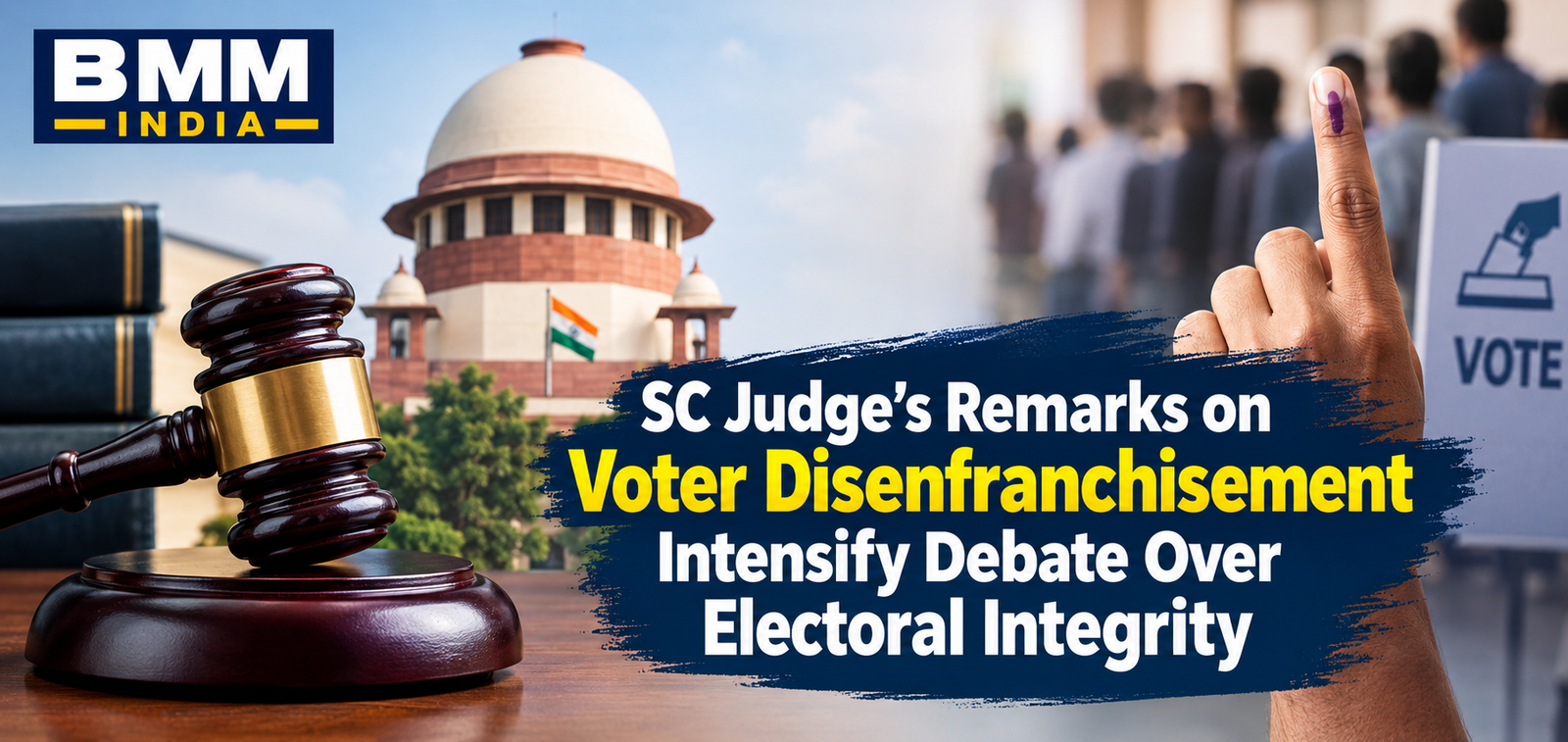
India’s ongoing debate over electoral reforms and voter verification processes intensified after Supreme Court Justice Ujjal Bhuyan stated that no amount of “whataboutery” can justify any process that results in voter disenfranchisement. His remarks have triggered strong reactions from opposition parties, which claim the comments have exposed serious concerns regarding the functioning of the Election Commission and the leadership of Chief Election Commissioner (CEC) Gyanesh Kumar.
Justice Bhuyan Raises Constitutional Concerns
Addressing an event on the topic of law, Justice Bhuyan has highlighted that any system which takes away voting rights from millions of citizens is inherently arbitrary and against the Constitution. The justice went on to explain that such measures create a situation whereby people are denied their voting rights, which is a violation of the fundamentals of democracy. As per Justice Bhuyan, the Constitution does not allow people to be arbitrarily excluded from the election process.
The remarks by the judge have been taken as a reference to the issue of electoral roll correction in view of the Special Intensive Revision (SIR) program currently going on.
Opposition Targets Election Commission
The political opposition quickly latched onto Justice Bhuyan’s statements, suggesting that his comments corroborate their ongoing fears about the recent decision-making by the Election Commission. Some leaders claimed that his statements revealed flaws in the electoral verification process and cast doubt on the leadership of the present CEC. Leaders from the Congress party and the political opposition have called for greater transparency and even demanded that Gyanesh Kumar resign.
According to the political opposition, the recent large-scale revision of electoral rolls raises fear of voter disenfranchisement, especially for those who may face difficulties in verification processes due to vulnerability. Electoral reform should focus on inclusion, not exclusion.
Growing Protests Across the Country
The issue has transcended the boundaries of the courtroom and politics and has now led to protests in various cities. People have been charging the election bodies with carrying out practices which may lead to the disqualification of legitimate voters from the electoral roll. There have been large protests held in Mumbai and Delhi calling for increased transparency in electoral processes.
There has been youth involvement in the protests alongside civil societies and opposition sympathizers who feel that in order for elections to be fair, it is important that everyone remains eligible to vote. The Election Commission, on the other hand, has said that the purpose of these verification drives is to ensure accuracy of electoral rolls.
Legal Challenges Ahead
It is now expected that the matter will be examined by the courts. There have been various petitions filed in the Supreme Court on some of the decisions made by the Election Commission, such as those regarding the SIR process and other associated administrative activities. They believe that it might lead to voter disfranchisement on a wide scale.
As legal scholars point out, the hearings to come might carry much weight in terms of constitutional interpretations of voting rights and electoral processes. It might also play an important role in shaping future electoral reforms in the country.
Why the Debate Matters
The core of the debate revolves around the basic question of democracy: how can the election commissions ensure voter roll accuracy while avoiding voter disenfranchisement? Comments by Justice Bhuyan will only raise more doubts about the fact that efficiency should not be allowed to compromise the fundamental rights enshrined in the Constitution. With the political atmosphere heating up and the case being contested in court, it is sure to be a major national debate in the coming months.
The debate brings to focus the need for striking a balance between the purity of elections and the inclusion of voters.