
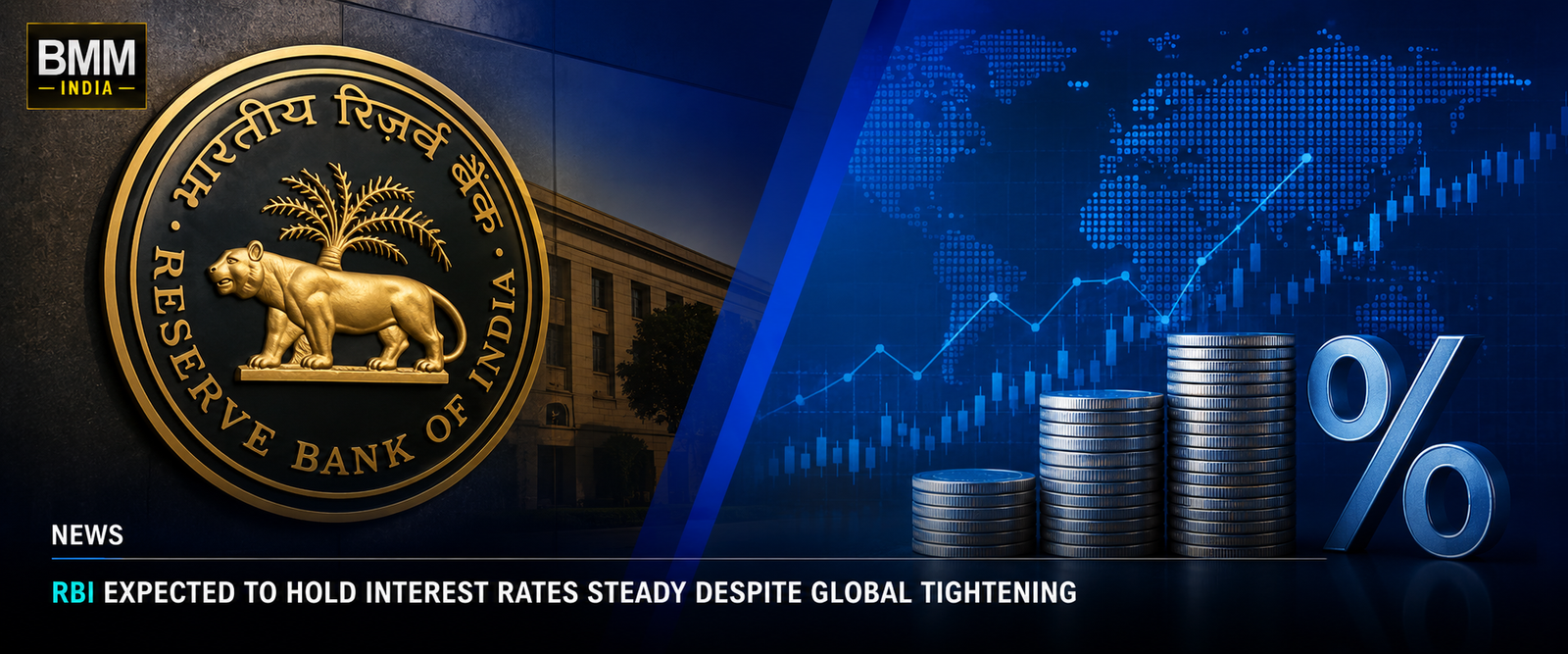
The RBI interest rate decision this week is expected to keep borrowing costs unchanged, even as several major central banks across the world continue raising interest rates to combat inflation. Economists believe the Reserve Bank of India (RBI) has enough room to maintain its current policy stance because domestic inflation remains relatively contained despite persistent global uncertainties.
A Reuters poll found that an overwhelming majority of economists expect the RBI’s Monetary Policy Committee (MPC) to leave the benchmark policy rate unchanged while adopting a slightly more cautious tone regarding future inflation risks. This RBI interest rate decision reflects the central bank’s effort to balance economic growth with price stability rather than reacting immediately to global monetary trends.
Why the RBI Can Afford to Wait
Unlike other economies suffering from persistent inflation problems, Indian economy continues to be lucky with stable prices of consumer goods. Inflation rate in retail reached 4.38 percent in June, slightly exceeding the 4 percent medium-term target of the Reserve Bank of India, yet remaining within its tolerance range of 2 to 6 percent. Also, core inflation (excluding food and fuel prices) is holding close to 4 percent.
This environment allows the RBI interest rate decision to prioritize economic stability rather than rushing into higher borrowing costs. While wholesale inflation has increased sharply, policymakers believe much of the pressure remains supply-driven and has not yet translated into sustained consumer inflation. Economists expect the RBI to continue monitoring incoming data before making any significant policy adjustments.
Global Central Banks Have Taken a Different Route
However, India’s stance is contrary to many of its peers around the globe. With the rise in oil prices on account of the geopolitical situation in the Middle East, the Central Banks of Europe, Australia, Indonesia, Philippines, Singapore, South Korea, and South Africa have all gone in for higher interest rates so as to rein in inflationary pressures.
The upcoming RBI interest rate decision therefore positions India as one of the few major economies maintaining a wait-and-watch strategy rather than joining the latest global tightening cycle..
Currency Support Measures Ease Immediate Pressure
Rather than hiking up the interest rates, the RBI has come up with policies that will encourage foreign investments. This includes abolishing capital gain taxes for some foreign investors for investing in government securities, as well as improving the terms for non-resident Indian dollar deposits. It is said that these steps have brought almost $40 billion of foreign money into the country.
Though the rupee has gained its stability due to low oil prices and improved foreign investments, it is expected that RBI interest rate decision will be watched closely in case of uncertainties in the international scenario.
Markets Expect Future Tightening
Although a policy pause looks imminent, markets have been increasingly pricing in the possibility of future actions as the risks of inflation rise. Interest rate swaps currently point to expectations of about 75 basis points of total interest rate increases over the next one-year period.
According to several economists, a more hawkish approach to communications by the RBI will see the central bank acknowledge increasing inflation expectations while stressing data dependency of any future decisions. This is because the RBI interest rate decision does not imply an immediate change in interest rates but sets up expectations of future tightening.
Outlook
The impending RBI interest rate decision is an indication of the level of confidence the central bank has in the present macroeconomic condition of India, irrespective of the difficult global environment. The favorable inflation level, positive foreign investments, and careful handling of the situation give the RBI enough scope to not increase rates immediately. However, with the future uncertainties of oil prices, global geopolitics and inflationary pressures, the government needs to be watchful. The present decision might only buy time.
Also Read : –Delimitation in India: The Political Storm Behind the Women’s Reservation Bill