
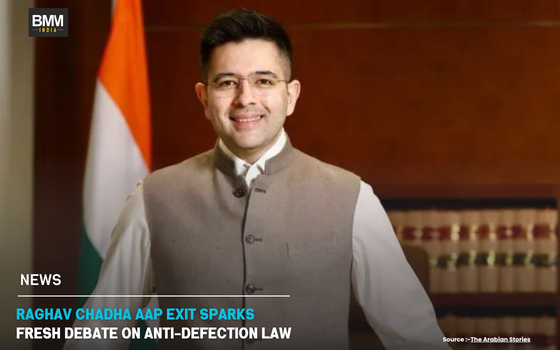
Raghav Chadha, once seen as one of the strongest young faces of the Aam Aadmi Party (AAP), is now at the center of one of the biggest political controversies of 2026. His decision to leave AAP and lead six other Rajya Sabha MPs toward the Bharatiya Janata Party (BJP) has created a major political storm and raised serious questions about party loyalty and constitutional ethics.
The Raghav Chadha AAP exit is not just a leadership shift, it has triggered a national discussion on India’s anti-defection law and the legal protection available to lawmakers who switch political sides.
From AAP’s Rising Star to Its Biggest Political Setback
Raghav Chadha is one of the most trusted leaders of AAP and a confidante of Arvind Kejriwal. He has played a crucial role in elevating the party from a local to a national party, has been elected from Rajinder Nagar as an MLA, was the Vice Chairman of the Delhi Jal Board and was elected from Punjab as a Rajya Sabha MP in 2022.
Despite Chadha’s political track record, the Raghav Chadha AAP exit came as a surprise. His resignation, along with that of six other Rajya Sabha MPs, led to an AAP numbers game in Parliament, and a legal challenge.
Why Raghav Chadha Left AAP?
In his resignation letter, Chadha said the party has “completely moved away from its principles, values and morals”. He claimed the AAP is not serving the country, and is working for its political and personal gain.
He also famously declared, “I am the right man in the wrong party” which became one of the main talking points of the resignation crisis.
The Raghav Chadha AAP exit has been in the making for a while, with increasing tensions and his isolation from the party. He was removed from his key roles in the Rajya Sabha and this was a sign of the divide.
The Anti-Defection Law and the Two-Thirds Rule
The court case over the Raghav Chadha move from AAP involves the anti-defection law (Tenth Schedule of the Constitution). The legislation aims to stop members of parliament from joining another party for personal benefit, for ministerial posts, or for political advantage.
But there’s a catch. If two-thirds of the lawmakers of a party want to “split” and join another political party, they can be exempted.
As seven of the ten AAP Rajya Sabha members resigned together, Chadha and his colleagues contend that they fit this exception and should not be disqualified.
But AAP has questioned this move and requested the Rajya Sabha Chairman to declare it a defection and take action against these MPs.
The Irony of Chadha’s Earlier Stand
The rague Chadha AAP defection also comes amid Chadha’s earlier stance on MPs who have defected. Earlier, he had called for stronger anti-defection laws and even proposed amending the constitution to stop “horse-trading”.
He claimed that faster action should be taken against MPs who leave a party and that there should be greater protection against “a blot on our democracy”.
Yet many are questioning his actions in light of his comments.
Conclusion
The Raghav Chadha AAP exit is not just a political manoeuvre, but a critical moment in Indian politics. His defection has dented the strength of AAP in the Rajya Sabha, it has boosted the BJP and also reignited a debate about the question of democratic accountability.
While it remains to be seen whether this is a smooth political move or a long battle, one thing is for sure: Raghav Chadha’s departure has altered the political landscape, and restarted a debate about India’s anti-defection law.
Also Read : – Delimitation in India: The Political Storm Behind the Women’s Reservation Bill