
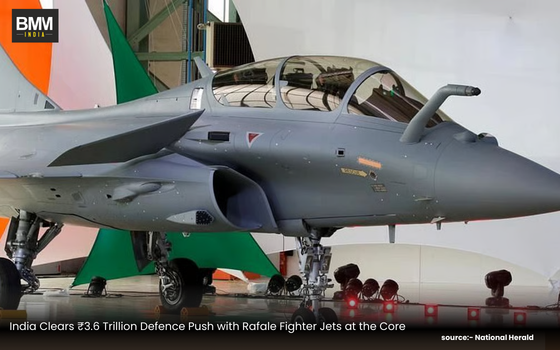
India has given initial clearance to a massive ₹3.6 trillion ($40 billion) defence procurement programme, placing Rafale fighter jets at the centre of a sweeping military modernisation drive. The approval was granted by the Defence Acquisition Council (DAC) and covers acquisitions for the air force, navy, and army, as New Delhi responds to rising regional tensions and shrinking frontline capabilities.
The proposals include the purchase of additional Rafale fighter jets and missiles for the Indian Air Force, long-range maritime reconnaissance aircraft for the navy, and advanced anti-tank missile systems for the army. The defence ministry confirmed the overall value of the cleared proposals but did not disclose platform-specific quantities or timelines.
Fighter Squadron Shortfall Drives Air Force Focus
The Indian Air Force (IAF) is in a dire situation because it doesn’t have enough combat aircraft. Its fighter squadron strength has dropped to 29, which is well below the allowed level of 42. The MiG-21 will be retired in September, which makes the need for new planes even more urgent. Other older planes, like early MiG-29 variants, the Jaguar, and the Mirage 2000, are also expected to be phased out in the next few years.
Against this backdrop, Rafale fighter jets have emerged as a key solution to bridge capability gaps quickly. The IAF already operates Rafale aircraft supplied by Dassault Aviation, and officials view the platform as a proven multirole asset capable of air dominance, deep strike, and maritime operations.
Earlier in the day, local news outlets said that the DAC had given the go-ahead to buy 114 more Rafale planes, which could be worth ₹3.25 trillion. The defense ministry hasn’t officially confirmed these numbers, but the reports show how big India’s plans for air power are.
Navy and Army Procurement Plans
The clearance also makes India’s land and sea combat abilities stronger, in addition to the air force. The Navy is going to buy more P-8I maritime reconnaissance planes from Boeing. This will greatly improve surveillance, anti-submarine warfare, and intelligence-gathering operations in the Indian Ocean region.
For the army, the DAC approved proposals for modern anti-tank missile systems, aimed at improving combat readiness along sensitive borders. Together, these acquisitions reflect a broader push to modernise all three services in parallel, with Rafale fighter jets forming the most visible and strategically significant component of the programme.
Domestic Manufacturing and Tejas Programme
India still needs to buy high-end combat planes from other countries, but under Prime Minister Narendra Modi, the government has stepped up its efforts to boost domestic defense manufacturing. The Tejas light combat aircraft made by Hindustan Aeronautics Limited (HAL) is a key part of this plan.
The IAF has nearly 180 Tejas Mk-1A fighters on order, intended to replace Soviet-era MiG-21s. However, deliveries have been delayed due to engine supply chain disruptions linked to GE Aerospace. These delays have further increased reliance on platforms such as Rafale fighter jets to maintain operational strength in the near term.
Strategic Timing and France Relations
The DAC approvals come just before French President Emmanuel Macron’s trip to India, which shows how the defense partnership between New Delhi and Paris is growing. The Rafale fighter jets that India already has are a symbol of this strategic relationship.
India signed a deal in April to buy 26 Rafale-Marine planes, both single- and twin-seat versions, to use on its aircraft carriers INS Vikrant and INS Vikramaditya. The deal meant that Rafale jets would be able to fly from Indian naval platforms for the first time, which would make their role in all services even bigger.
Coast Guard Deal and Next Steps
The defense ministry also signed a deal with HAL to buy eight Dornier 228 planes for the Indian Coast Guard. This will improve coastal surveillance and maritime security.
The DAC’s approvals are just the first step. In the coming months, they will lead to detailed business talks and technical reviews. If everything goes as planned, the program will be one of the biggest defense procurement efforts in India’s history, with Rafale fighter jets as the backbone of its future air power.
Also Read : – Shielding the Skies: Understanding the Indian Air Defence System and Its Key Assets