
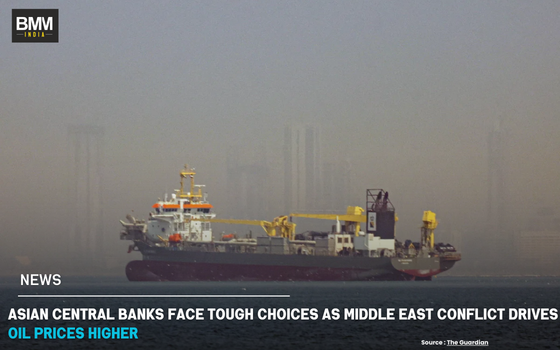
The Middle East conflict is reshaping the economic outlook for Asia, forcing central banks across the region to weigh the difficult trade-off between controlling inflation and supporting economic growth. With oil prices surging past $110 per barrel amid escalating geopolitical tensions, policymakers are confronting rising energy costs, currency volatility, and the growing risk of stagflation.
Financial markets reacted sharply to the crisis, with Asian share markets declining and investors rushing toward the safe-haven U.S. dollar. The surge in oil prices has heightened concerns that the Middle East conflict could disrupt global energy supplies for an extended period, creating inflationary pressure across import-dependent economies in Asia.
Oil Prices Shock Complicates Monetary Policy
The Middle East conflict has intensified pressure on emerging Asian economies that rely heavily on imported energy. Rising crude prices increase transportation and manufacturing costs, which often translate into higher consumer prices.
For central banks, this creates a difficult policy dilemma. Raising interest rates could help contain inflation, but doing so risks slowing economic growth at a time when many countries are still navigating fragile recoveries.
India’s central bank, for example, is expected to prioritize economic growth rather than rush toward rate hikes. According to sources familiar with the matter, the Reserve Bank of India is likely to keep interest rates relatively low to support domestic demand and economic stability.
Economists note that the Middle East conflict has also strengthened the U.S. dollar, which is attracting investors seeking safer assets. This shift in capital flows could weaken emerging market currencies, forcing central banks to intervene in foreign exchange markets to stabilize their currencies.
Currency Pressure Adds to Challenges
The Middle East conflict is not only affecting inflation but also increasing volatility in currency markets. As investors move money into the U.S. dollar, Asian currencies face downward pressure.
For countries like India, currency stability has become a key concern. Analysts expect the central bank to intervene in foreign exchange markets to prevent excessive volatility in the rupee. Such interventions often require injecting liquidity into the banking system to maintain financial stability.
Economists say the immediate focus for policymakers may be managing currency fluctuations rather than raising interest rates.
Southeast Asia May Shift Policy Stance
The central banks of Southeast Asian countries may also re-institute their monetary policies due to the Middle East conflict. Other countries like Thailand and Philippines that had been following an accommodative policy approach may require tightening their policy in case the inflation persists.
Through the increased fuel prices, it can easily be transmitted to the rest of the economy and increase the prices of goods and services. When inflation starts increasing at an unacceptable rate, central banks would be forced to intervene, although this would slow down the economy.
Analysts caution that the long term effects of geopolitical tensions are higher chances of stagflation, which is a situation where the economy is experiencing sluggish growth and prices are rising.
Export Economies Face Additional Risks
Such economies as South Korea and Japan which are manufacturing-oriented are especially susceptible to the economic impacts of the conflict in the Middle East. Global trade and stable supply chains are key to these countries and both of them are under threat because of increased energy prices and political unrest.
The interest rates in South Korea have been maintained so far by the central bank and any increase in inflation is being monitored by the policy makers. In case inflation has continuously exceeded the target of the central bank, the governments might turn hawks in the near term.
Nonetheless, government actions in stabilizing domestic fuel-prices can help in cushioning the inflationary effects of the increase in oil prices in the near-term.
Japan’s Growth Outlook at Risk
Japan is also under economic threat in case oil prices rise. Studies have estimated that the long-term crude oil prices would be below the economic growth in the country when crude oil prices are sustained at about 110 per barrel.
Such an effect may be a significant challenge to an economy that already has relatively low growth rates. The Middle East war is thus a source of further uncertainty to the Japanese economic prospects.
Global Central Banks Under Pressure
The Middle East conflict has its ripple effects that are not only in Asia. It is also a challenge of balancing between inflation control and economic growth that is difficult to do in developed economies such as the United States.
With geopolitical tensions unabated, central banks around the world might be called upon to relook at their policy strategies to help them contain increased energy prices, volatile financial markets and changing global capital flows.
There is no apparent end to the conflict in the Middle East so, in the months ahead, the Middle East conflict is destined to continue as a key influence on the formulation of monetary policies in Asia.
Also Read :- Indian Refinery Stocks Fall as Oil Prices Surge Amid Middle East Conflict