
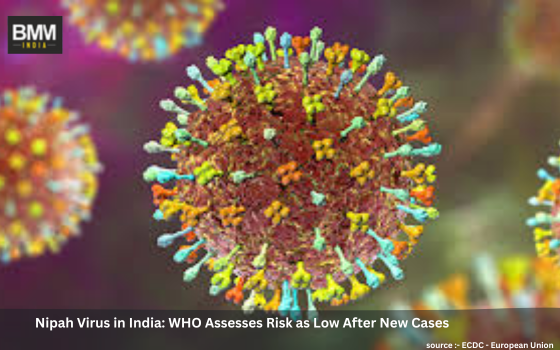
The World Health Organization has stated that the risk of the Nipah virus in India spreading internationally remains low, following the confirmation of two new infections in late December. In a statement shared with Reuters, the global health body emphasized that it does not recommend imposing travel or trade restrictions related to the recent cases.
Despite heightened airport screening measures introduced by several Asian countries, the WHO maintains confidence in India’s public health infrastructure and outbreak response capacity. According to the agency, there is currently no evidence of increased human-to-human transmission linked to the latest infections, reinforcing the assessment that the overall risk associated with the Nipah virus in India remains contained.
Heightened Vigilance Across Asia
Following India’s confirmation of the infections, regions including Hong Kong, Malaysia, Singapore, Thailand, and Vietnam tightened airport health screening protocols. These precautionary steps were taken to guard against the potential spread of the Nipah virus in India, even though the WHO has not advised such measures.
Public health officials across Asia remain alert due to the virus’s high fatality rate and its classification as a priority pathogen. However, experts stress that the virus does not spread easily between humans and typically requires prolonged close contact, making widespread transmission unlikely under current circumstances.
Understanding the Nipah Virus
The Nipah virus in India is not a new public health concern. The virus is zoonotic, meaning it spreads from animals to humans, primarily through fruit bats. Humans can become infected by consuming fruits contaminated by bats or through contact with infected animals such as pigs. In rare cases, limited person-to-person transmission has been documented.
Nipah infection can lead to fever, respiratory issues, and severe brain inflammation (encephalitis) in clinical settings. The virus has a death rate of between 40% and 75%. There is currently no licensed cure or vaccine, but several candidates are being tested in clinical trials.
Current Cases and WHO Coordination
The two recently reported cases of the Nipah virus in India involve health workers from the eastern state of West Bengal, according to local authorities. Both individuals are receiving hospital care, and contact tracing efforts are ongoing.
The WHO has said that it is working closely with Indian health officials to keep an eye on the situation. The agency said that more exposure can’t be completely ruled out because the virus is found in bat populations in parts of India and nearby areas.
Nipah Virus in India: A Recurrent Challenge
Over the past 20 years, India has had a few outbreaks of the Nipah virus, mostly in the southern state of Kerala, which is thought to be one of the most dangerous places in the world for the virus. Nipah outbreaks have been linked to dozens of deaths since they first appeared there in 2018.
The current outbreak is the seventh time the Nipah virus has been seen in India and the third time it has been seen in West Bengal. In 2001 and 2007, there were outbreaks in the state that were close to Bangladesh, where Nipah outbreaks happen almost every year.
Why Nipah Remains a Priority Pathogen?
The WHO still considers the Nipah virus in India to be a top-priority pathogen because it kills a lot of people, there are no approved treatments for it, and there is a theoretical chance that it could change into a form that spreads more easily. Virologists, on the other hand, stress that small, localized outbreaks are common and that the risk to the general public is still low.
As surveillance and containment efforts continue, global health authorities say that the right response to the Nipah virus in India is to be alert, not panic.
Also Read :- Business Minds Media India For more information