
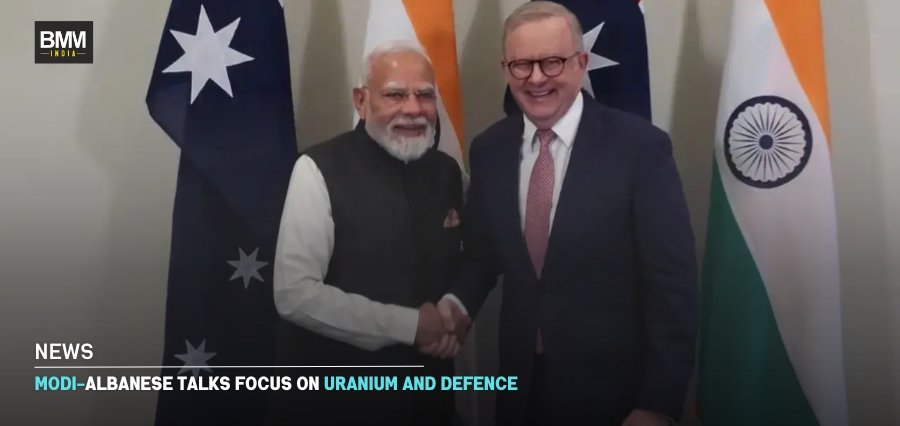
Indian Prime Minister Narendra Modi is set to hold formal discussions with Australian Prime Minister Anthony Albanese as the two countries seek to expand cooperation across nuclear energy, defence, critical minerals and trade. The meeting comes during Modi’s visit to Australia and reflects the growing strategic importance of bilateral relations in the Indo-Pacific region.
The India-Australia Strategic Partnership has gained momentum in recent years as both nations explore opportunities to strengthen economic ties, improve regional security and support the transition towards cleaner energy. Discussions between the two leaders are expected to focus on Australia’s uranium resources, defence collaboration, and long-term investment opportunities.
Uranium Cooperation Gains Strategic Importance
India plans to develop its nuclear power generation capacities in order to meet the rising electricity demands of the country in an attempt to decrease reliance on fossil fuels. It is planned that India will have up to 100 gigawatts of nuclear power capacities by 2047, which makes the supply of reliable uranium crucial.
There are large deposits of uranium located in Australia, which can serve as a source of help for the nuclear goals of India. Despite the fact that India and Australia signed an agreement regarding civil nuclear cooperation in 2014, the uranium trade between them was low because of the safeguard issue.
Reports suggest that a long-awaited agreement concerning Australian uranium exports to India could move closer to completion. Progress in this area could become a major milestone for the India-Australia Strategic Partnership, providing India with greater access to nuclear fuel while creating new opportunities for Australia’s resources sector.
Clean Energy and Critical Minerals Open New Opportunities
At an economic roadmap business event between Australia and India in Melbourne, Modi pointed out possibilities of collaboration in nuclear and renewable energies, green hydrogen, and critical minerals, calling the relationship “historic opportunities.”
Resources of Australia, its advanced technology, and investment skills can help India transition into renewable energy and build infrastructure. Cooperation in the manufacturing of sustainable aluminum, among others, is also anticipated. The India-Australia Strategic Partnership could enable both countries to build more resilient supply chains for minerals required in electric vehicles, renewable energy technologies and advanced manufacturing. Such cooperation may also help reduce dependence on concentrated global supply networks
Defence Cooperation Takes Centre Stage
It is envisaged that regional security will be an important part of the conversations between Modi and Albanese. India and Australia have both become active in the Indo-Pacific region amid the ongoing geopolitical and security challenges in the region.
Greater collaboration could include joint military exercises, maritime security initiatives, defence technology partnerships and stronger coordination on regional challenges. Expanding defence engagement under the India-Australia Strategic Partnership may contribute to maintaining stability and supporting a rules-based regional order.
Modi arrived in Australia after visiting Indonesia, where India signed several agreements covering agriculture and defence, including cooperation involving the BrahMos cruise missile system. His wider diplomatic tour highlights India’s efforts to deepen political, economic and security relationships across the Asia-Pacific region.
Australia Looks to Diversify Economic Relations
Strengthening ties with India also supports Australia’s efforts to diversify its international trade relationships beyond China, its largest trading partner. India currently ranks as Australia’s fifth-largest trading partner, highlighting the potential for further growth across infrastructure, energy, education, technology and investment.
Modi encouraged Australian businesses and institutional investors to make long-term investments in India’s roads, ports, railways and urban infrastructure. During the visit, AustralianSuper announced an additional investment of A$500 million in India’s National Investment and Infrastructure Fund.
The investment demonstrates growing confidence in the India-Australia Strategic Partnership and reflects increasing interest among Australian institutions in India’s expanding economy and infrastructure requirements
People-to-People Connections Strengthen Relations
The Indian community has developed into an integral part of Australian society, as roughly one million Australians have claimed to be of Indian descent. Modi will speak to a large number of Indians who have settled in Australia at a major gathering in Melbourne.
According to Albanese, Modi was a “living bridge” connecting India and Australia, and his vision helped shape Australia’s developing economic relationship with India. The strong ties that bind Indian culture and community continue to be a solid base for the Strategic Partnership between India and Australia.
A Broader Vision for Long-Term Cooperation
Modi and Albanese’s summit may set the future course of relations between the two nations through increasing collaboration in areas such as energy security, defense, critical minerals and infrastructure investments. Uranium exports would be a very important accomplishment which can help meet the long-term goals for clean energy in India.
Given the need for stronger economic ties and regional cooperation by both nations, it is expected that the India-Australia Strategic Partnership will play a more important role in the Indo-Pacific region. The results of the discussions can open up new avenues of investments, technology exchange and security cooperation for both nations.
Also Read :-West Bengal Exit Poll 2026 Signals Tight Battle After High Voter Turnout