
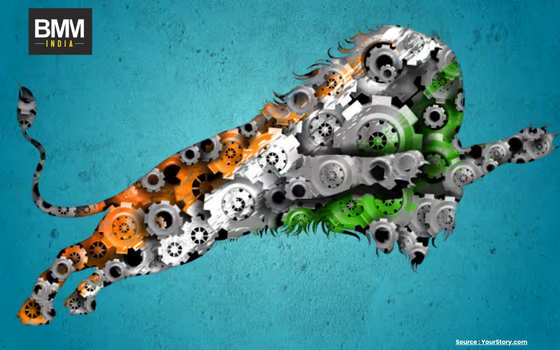
For years, India was seen primarily as the world’s back office, powering global corporations through IT services and outsourcing. That narrative is now evolving. Made-in-India Tech is no longer limited to services. Indian companies are building products that compete confidently in international markets, from SaaS platforms and fintech solutions to consumer electronics and deep tech innovations.
This transformation reflects a deeper shift in ambition. Indian entrepreneurs are no longer content with cost arbitrage models. They are building intellectual property, exporting digital platforms, and creating globally recognized brands.
The Rise of Made-in-India Tech in the SaaS Revolution
One of the strongest pillars of Made-in-India Tech is software as a service. Indian SaaS firms are designing products used by businesses worldwide, often competing directly with American and European counterparts.
Companies like Zoho have shown that it’s possible to grow to a global scale without moving their headquarters to another country. Zoho serves customers in more than 180 countries. The company makes all of its enterprise software in India while keeping its R&D operations strong in India.
Freshworks also got a lot of attention around the world when it was listed on the Nasdaq. This shows that Made-in-India Tech products can attract both international investors and business customers.
India’s SaaS ecosystem is getting better because it has a lot of highly skilled engineers, low development costs, and a growing focus on products. Startups now think about global markets from the start, instead of just one geography.
Hardware and Electronics Manufacturing Gains Ground
Beyond software, Made-in-India Tech is also expanding into electronics manufacturing and hardware design. Government initiatives such as Make in India and production linked incentive schemes have encouraged domestic manufacturing of smartphones, semiconductors, and electronic components.
Indian companies are making their own hardware ecosystems, and more and more global brands are putting together devices in India. The country has become one of the biggest places in the world to make smartphones, meeting both domestic and export needs.
This change makes India less dependent on imports and makes it a stronger option for a reliable supply chain in a world that is politically divided.
Fintech and Digital Public Infrastructure as Competitive Advantages
Another major driver of Made-in-India Tech is the country’s digital public infrastructure. Platforms such as Unified Payments Interface have revolutionized digital payments domestically and drawn global attention.
Indian fintech startups are using this infrastructure to create payment, lending, and financial inclusion solutions that can grow. Some of these companies are selling their technology frameworks to other countries or helping those countries set up similar systems.
Aadhaar, UPI, and digital identity frameworks coming together has made a place for new ideas to grow. Startups can test their products on a large scale, quickly improve them, and then make them work in other countries.
Deep Tech and Emerging Sectors
Made-in-India Tech is also making strides in artificial intelligence, space technology, health tech, and climate innovation.
Indian space startups are working on technologies for launching satellites and observing the Earth. Companies that make health tech are making cheap diagnostic tools that are perfect for new markets. AI-powered platforms are being used in a wide range of fields, from farming to shipping.
This diversification shows that the company is growing up. India is no longer limited to low-margin markets. It is moving into complicated, high-value fields that need a lot of research and precise engineering.
Global Mindset, Local Execution
Indian of the characteristics of Made-in-India Tech is the global orientation. Founders are creating products that are internationally compaliant, multilingual, and distributed to users.
The remote work culture has enabled Indian firms to employ any worker anywhere in the globe and attend to their clients in a foreign time zone. The role of India in international trade is also increasing because the export earnings of technology products continue to increase.
Meanwhile, good demand on the domestic market provides a steady launching pad. India is one country where startups can first test their ideas before expanding to other countries due to its over a billion potential customers.
Challenges on the Global Stage
Despite impressive progress, Made-in-India Tech faces hurdles. Global competition is intense, particularly from Silicon Valley and Chinese manufacturers. Brand perception remains a challenge in certain markets where Indian products are still associated more with services than premium innovation.
We also need to make it easier for people to get large amounts of R&D funding and deep tech capital. We need to keep an eye on protecting intellectual property and making sure that rules are the same in all export markets.
However, these problems are being met more and more with coordinated policy support, private capital investment, and the resilience of the founders.
The Future of Made-in-India Tech
The next decade could define India’s global technological identity. Made-in-India Tech is evolving from a slogan into a measurable economic force. Product exports are rising. Indian startups are entering global indices. Domestic manufacturing is expanding.
The most important thing is that the way people think has changed. Business owners are building for the long term, not just for short-term value spikes. They are putting money into research, design, and building their brand.
India is in a good position because global supply chains are becoming more diverse and digital adoption is speeding up. It has a strong population, a lot of engineering talent, and an expanding infrastructure that make it a hub for development and a powerhouse for products.
It’s not about catching up with Made-in-India Tech anymore. It’s about being able to compete with confidence and, in many cases, being the first to come up with new ideas that are cost-effective, scalable, and accessible to everyone.
Indian goods are not only going to other countries. They are making them.
Also Read :- India’s Creator Economy: How Content Creators Are Becoming Serious Businesses