
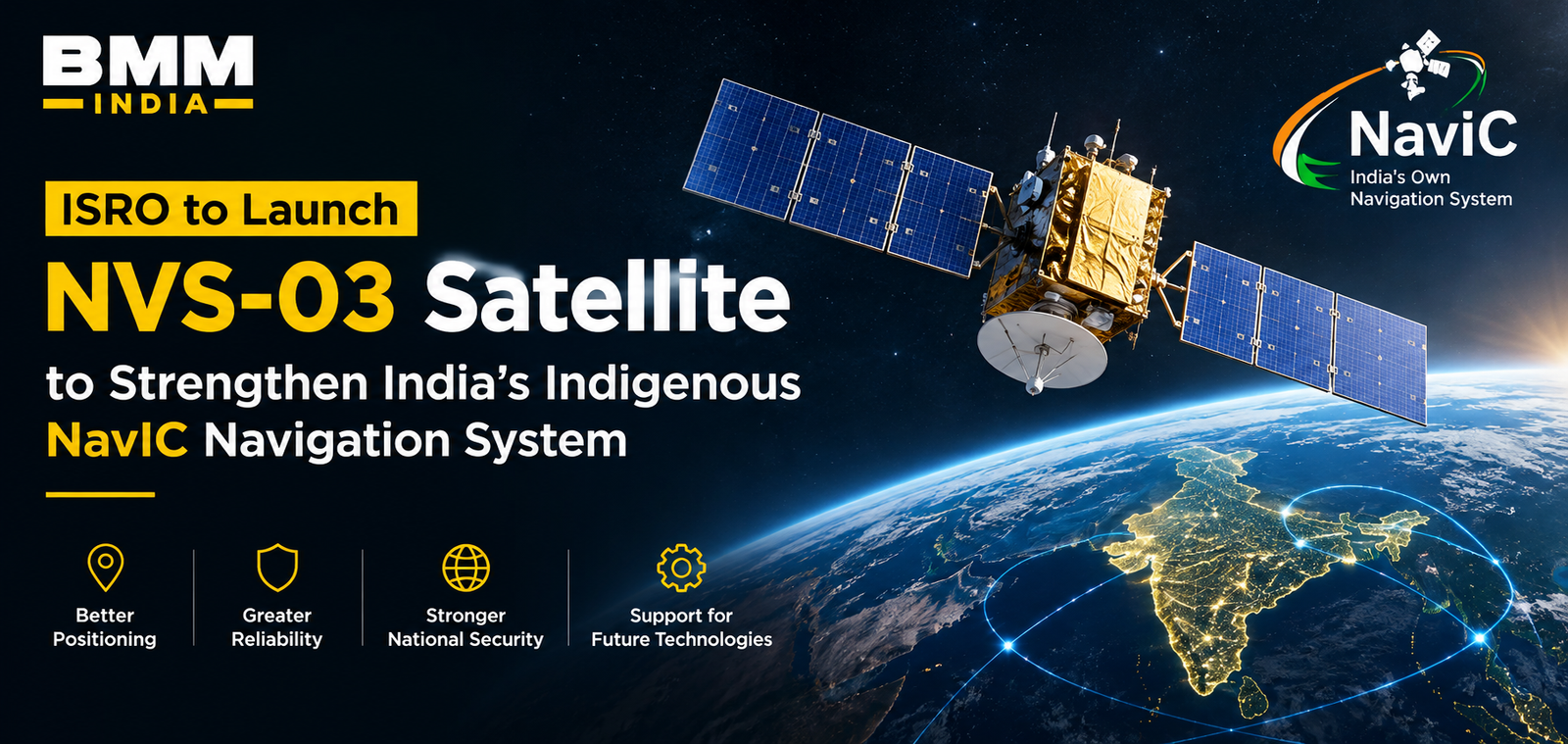
The Indian Space Research Organisation (ISRO) is preparing to launch its next-generation navigation satellite, NVS-03, on October 30, 2026, in a significant step towards strengthening India’s independent satellite navigation capabilities. The NVS-03 satellite launch is scheduled for 11:51 pm IST aboard the Geosynchronous Satellite Launch Vehicle (GSLV-F18) from the Satish Dhawan Space Centre in Sriharikota, Andhra Pradesh.
The mission aims to improve the reliability of Navigation with Indian Constellation (NavIC), India’s indigenous alternative to international satellite navigation systems. The GSLV-F18 mission will mark the 20th flight of the country’s Geosynchronous Satellite Launch Vehicle. ISRO plans to place the satellite into a geosynchronous transfer orbit before moving it towards its designated operational orbit.
Advanced Technology to Enhance Navigation Services
The NVS-03 satellite launch is part of ISRO’s second-generation navigation satellite programme, designed to maintain continuity and improve the capabilities of the Indian Regional Navigation Satellite System (IRNSS), now known as NavIC.
Weighing around 2,250 kg, NVS-03 would be equipped with an indigenous atomic clock along with some acquired atomic clocks. Atomic clocks are crucial for the satellite navigation process, as accurate time calculation helps determine the location based on information received from various satellites.
Another key aspect is the inclusion of the L1 frequency along with the already existing L5 and S frequencies. This would be helpful in improving the compatibility with various civilian navigation systems as well as accurate positioning and timing applications.
ISRO believes that the Indian Navigation System will cover the entire geographical area of India along with a region extending up to 1,500 kilometers beyond the geographical limits of India.
NavIC Faces Operational Challenges
The NVS-03 satellite launch follows NavIC’s struggles against technical challenges that have hindered its positioning service capability.
In January 2025, the ISRO launched the NVS-02 satellite through the GSLV-F15 launcher. While the satellite was able to make it into its primary orbit, it failed to perform all the necessary manoeuvres for reaching its intended orbit due to a technical issue within its propulsion system.
It was later discovered that there was a malfunction in the signal transmission component regarding the oxidizer line pyro valve of the orbit raising phase. The ISRO’s review team made recommendations for the necessary improvements, which were included in the succeeding missions.
The launch of NVS-03 is thus an important step towards improving the satellite constellation, assuming that it makes it through its necessary orbital manoeuvres and activation process.
Why the Mission Matters for India
Use of NavIC in positioning, navigation and timing services can be made for civilian as well as strategic purposes. Transportation services, maritime navigation, disaster management, and infrastructure monitoring can all use NavIC as a viable solution. An indigenous and reliable system would make India less dependent on the navigation services of other nations.
NVS-03 satellite launch is significant owing to the fact that the previous constellation of satellites was having difficulty achieving the minimum number of satellites necessary for providing independent positioning services. It has already been mentioned by the government that at least four satellites are necessary for positioning services.
More Satellites Needed for Long-Term Reliability
However, regardless of how important the NVS-03 satellite launch will be for NavIC, the launch itself will not be able to fully restore all of NavIC’s functions. In order for it to start serving its functions properly, the satellite will have to reach its orbit, be tested and become operational.
In addition to the mentioned satellite launch, ISRO is going to launch several other satellites, which will be called NVS-04 and NVS-05. The success of their launches will play a key role in developing NavIC system further.
In any case, the mission that is planned for January 28 will be one more step in developing India’s space infrastructure.