
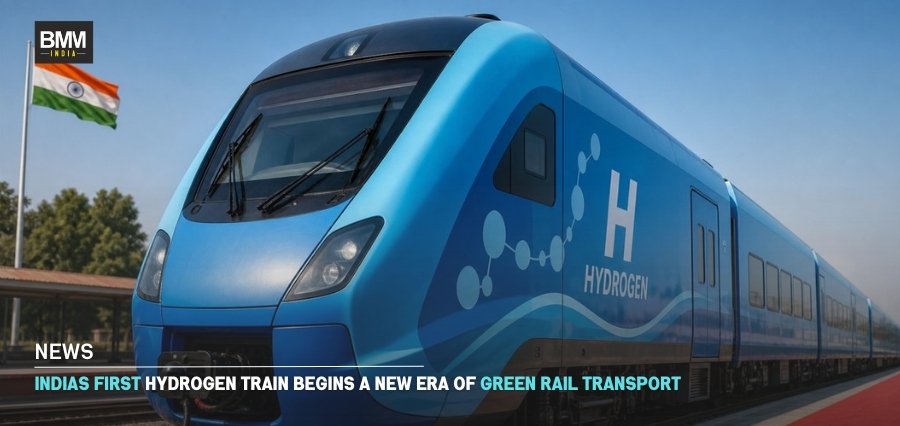
India has entered a new chapter in sustainable transportation with the launch of India’s first hydrogen train, flagged off by Prime Minister Narendra Modi in Haryana. The milestone marks the country’s entry into a select group of nations that have successfully introduced hydrogen-powered rail technology, reinforcing India’s commitment to cleaner mobility and reduced carbon emissions.
The hydrogen-powered train will operate between Jind and Sonipat in Haryana, serving as a pilot project that could pave the way for wider adoption of hydrogen fuel technology across the Indian Railways network. The inauguration formed part of a broader development initiative during the Prime Minister’s visit, which also included projects worth approximately ₹14,700 crore across multiple sectors in Haryana.
Why India’s First Hydrogen Train Matters
The introduction of India’s first hydrogen train represents more than a technological achievement. It reflects India’s growing focus on developing environmentally sustainable transportation solutions that reduce dependence on fossil fuels.
As opposed to diesel engines, hydrogen trains produce electrical energy using hydrogen fuel cells, whose byproduct is nothing but steam. Consequently, this mode of energy production becomes extremely clean in terms of emissions.
Another benefit that comes from hydrogen trains is their ability to operate efficiently in those parts of railway tracks where full electrification does not make sense for economic reasons.
Advanced Engineering with Indigenous Innovation
Built by native technologies under the Make in India scheme, India’s first hydrogen train is proof of increased capabilities for engineering in India. The train consists of two hydrogen-powered driving coaches and eight passenger coaches, which makes it one of the biggest hydrogen-powered passenger trains in the world.
In addition, the hydrogen train project has facilities to produce, store, and refuel hydrogen at Jind. Various security measures have been taken to ensure the safety of the entire process of running the train.
Infrastructure Push Beyond Railways
In the very same week, India’s first hydrogen train was introduced alongside the laying of the foundations of projects worth around ₹14,700 crore in Haryana. The projects range from roadways to railways, urban infrastructure to health and other public utilities, which shows the government’s commitment to regional development.
The projects are expected to boost connectivity, improve logistics, provide employment, and help in the economic development of the state. In addition, the hydrogen train project will place Haryana at a strategic position for the development of green transport in India.
Strengthening India’s Green Mobility Vision
As countries around the world accelerate their transition toward low-carbon transportation, India’s first hydrogen train signals India’s intention to remain at the forefront of sustainable mobility innovation.
Hydrogen can be considered an important part of future clean energy systems as it facilitates transportation with high capacities but with very few emissions. Successful implementation of hydrogen rail transport will serve as an encouragement to other forms of transport and industries in the years ahead.
The project will also work towards India’s larger vision of renewable energy and green hydrogen to cut down carbon emissions and increase energy security.
Looking Ahead
The successful rollout of India’s first hydrogen train represents an important milestone for both Indian Railways and the country’s clean energy ambitions. In addition to bringing a new way of transport which is green, the initiative proves that India has the ability to develop cutting-edge transport technology by itself.
If the trial runs successfully, then the hydrogen-based trains will eventually be able to contribute to the railway modernization initiative of India, especially in cases where normal electrification is problematic. Along with the ongoing infrastructure development, this launch marks a big step towards the construction of a greener and smarter transport system.
Also Read : –Delimitation in India: The Political Storm Behind the Women’s Reservation Bill