
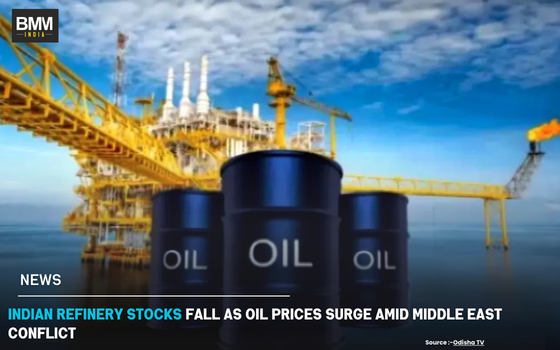
A sharp rise in global crude prices triggered a Indian refinery stocks fall on Monday as investors reacted to escalating tensions in the Middle East. The widening conflict involving the United States, Israel, and Iran has pushed Brent crude oil prices to their highest levels in nearly four years, raising concerns about the financial outlook for India’s oil marketing companies and increasing the possibility of government intervention.
The abrupt rise in oil prices has brought confusion in the energy markets across the world. The effect is especially apparent in India, which is one of the great consumers of imported crude oil. Cost increases cause a threat to the refinery margins and may ultimately affect the fuel pricing policies in the nation.
Major Indian Oil Companies See Market Losses
Leading state-run oil companies were among the hardest hit during Monday’s trading session as the Indian refinery stocks fall spread across the energy sector.
Indian Oil Corporation experienced a fall of 4.6 percent, and Hindustan Petroleum experienced a fall of 4.9 percent. The highest loss was Bharat Petroleum, which plummeted 5.4 percent and was moving toward the highest daily fall since June 2024.
The effect was also felt in the stock indices to a large extent. The Nifty oil and gas index dropped by 2.7 and the Nifty energy index dropped by 2.1 percent. In the meantime, the benchmark Nifty 50 index fell 2.8 percent, along with the overall market.
The oil and gas index has already decreased by approximately 6.6 percent since the U.S.-Israeli assault on Iran last week, and this may demonstrate the increasing investor worry in the sector.
India’s largest refiner, Reliance industries which is a private sector company, was also volatile. Its shares dropped by 0.4 percent following a decline of up to 2.5 percent during the day.
Rising Crude Prices Pressure Refiners
One of the main reasons behind the Indian refinery stocks fall is the rapid increase in global crude oil prices. Brent crude surged roughly 26 percent to reach $119.5 per barrel, marking the highest level since July 2022.
The price surge has been driven by supply disruptions and fears that the conflict could interfere with key shipping routes in the Middle East. Oil markets are particularly sensitive to developments in the region because a significant portion of global oil exports travels through the Strait of Hormuz.
For Indian oil marketing companies, rising crude prices directly affect profitability. According to analysts at UBS, companies like Indian Oil Corporation and Bharat Petroleum sell far more fuel than they produce. In fact, their fuel sales are roughly double their production levels, while Hindustan Petroleum’s gap is even larger.
This imbalance leaves refiners highly exposed to sudden increases in global crude prices.
As a result of these risks, UBS downgraded Indian Oil Corporation and Bharat Petroleum to “neutral” from “buy,” while Hindustan Petroleum was downgraded to “sell.”
Supply Cuts Deepen Market Concerns
The Indian refinery stocks fall has also been influenced by supply reductions from major oil producers in the Middle East.
Iraq and Kuwait have already begun reducing oil output, adding further pressure on global supply. At the same time, Qatar has cut liquefied natural gas shipments due to disruptions caused by the ongoing conflict.
These supply reductions are amplifying fears that energy markets could face a prolonged period of tight supply and volatile prices.
Analysts say that if the conflict continues to escalate, disruptions in the Strait of Hormuz could significantly affect global oil transportation. The narrow waterway handles roughly one-fifth of the world’s oil shipments, making it one of the most critical energy routes in the world.
Any disruption there could intensify the Indian refinery stocks fall as investors anticipate rising costs for crude imports.
India’s Heavy Dependence on Energy Imports
India’s vulnerability to global energy shocks stems from its heavy reliance on imported fuel. The country is one of the world’s largest energy consumers and depends on overseas suppliers for the majority of its crude oil and liquefied petroleum gas.
India is second largest LPG importer in the world, according to industry data. The nation used some 33.15 million metric tons of cooking gas last year, with imports taking almost two-thirds of all the demand.
A significant role in the source of energy for India belongs to the Middle Eastern nations. In India, the LPG imports are between 85 percent and 90 percent regionally obtained.
Due to this dependency, any geopolitical instability in the Middle East can soon spill over into India in terms of energy security and financial markets.
Analysts Warn of Prolonged Risks
Financial analysts warn that the Indian refinery stocks fall could continue if the geopolitical tensions persist.
According to the Citigroup analysts, the future earnings of the Indian refiners will be subject to the duration of the current crisis. Two other significant risks were also mentioned by them: the possible shutdown of the Strait of Hormuz and additional shutdowns of LNG in Qatar production.
The two aspects might cause a serious disruption in the energy supply chain of India.
More than a big percentage of the crude imports of India are through the Strait of Hormuz alone, and Qatar provides India with a considerable amount of LNG.
Any prolonged disruption of either of these supply channels would expose the refiners in India to higher costs and lower margins and put them under strain by regulators.
Outlook for India’s Energy Sector
Investors are yet to be satisfied since the world oil markets are responding to the conflict at hand. The current Indian refinery stocks are an indication of increased worry about the fact that the rise in the price of crude may lead to reduced refinery profits and more fuel price volatility.
Although other analysts are optimistic that the market response may level off in case the geopolitical tensions are resolved, some others caution that in the long term, additional market turbulence may be created through continual market disruptions brought about by energy supply routes.
With the Middle East situation still developing, the energy industry in India will still be closely linked to the trends in the global oil prices and the geopolitical situation.
Also Read :- Morgan Stanley Downgrades India Amid Rising Strait of Hormuz Supply Risks