
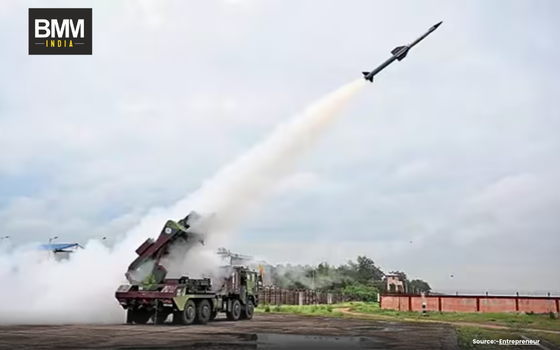
Air superiority and airspace protection are central to national security in the modern era. With evolving threats ranging from fighter aircraft and ballistic missiles to drones and cruise missiles, India has steadily built a layered and robust defensive architecture. The Indian Air Defence System represents this multi-tiered shield, designed to detect, track, and neutralise aerial threats before they can cause damage on the ground.
India has greatly improved its air defense systems over the past twenty years by developing its own systems and buying systems from other countries. This has made sure that it can defend itself at short, medium, and long ranges.
What Is the Indian Air Defence System?
The Indian Air Defence System is a network of sensors, command-and-control structures, interceptor aircraft, and surface-to-air missile systems that work together to protect Indian airspace. It is primarily operated by the Indian Air Force, with additional roles played by the Indian Army and the Indian Navy.
The system doesn’t just use one weapon; it uses a layered defense approach. Threats are dealt with at different distances and heights, which makes it more likely that they will be intercepted and less likely that they will launch saturation attacks.
Key Objectives of India’s Air Defence
The Indian Air Defence System is designed to achieve four main objectives.
First, early detection of hostile aircraft, missiles, and unmanned systems.
Second, you can track and identify threats in real time.
Third, interception and neutralization at the right distances.
Lastly, protecting important infrastructure like cities, military bases, nuclear plants, and strategic assets.
India combines radar networks, airborne warning systems, missile batteries, and fighter planes into a single command structure to reach these goals.
List of Major Air Defence Equipment Used by India
1. S-400 Triumf
The S-400 is India’s most advanced long-range surface-to-air missile system. Capable of intercepting aircraft, cruise missiles, and ballistic missiles at ranges of up to 400 km, it forms the outermost layer of the Indian Air Defence System. It can track multiple targets simultaneously and engage them with different interceptor missiles.
2. Akash Missile System
Developed indigenously by DRDO, the Akash missile system is a medium-range surface-to-air missile designed to protect mobile and static targets. It is one of the most widely deployed systems across India and plays a key role in point and area defence.
3. Akash-NG
An advanced version of Akash, Akash-NG offers improved range, faster reaction time, and enhanced accuracy. It strengthens the middle layer of the Indian Air Defence System and reflects India’s push for self-reliance in defence technology.
4. Barak-8
The Indian Navy and Air Force use Barak-8, a medium-range surface-to-air missile system that was made by both India and Israel. It is important for both land and naval air defense because it is made to stop aircraft, UAVs, and sea-skimming missiles.
5. MR-SAM
The Medium Range Surface to Air Missile system can protect against threats from the air up to about 70 km away. It fits in between short-range point defense systems and long-range systems like the S-400.
6. Spyder Air Defence System
The Spyder system is a low-level air defense system that can quickly stop planes, helicopters, and drones. It works especially well against surprise attacks and is very important for protecting airbases.
7. Pechora Missile System
Although older, the Pechora system remains operational after upgrades. It continues to serve as a backup layer within the Indian Air Defence System, especially for fixed installations.
8. Igla MANPADS
Ground troops use Man-Portable Air Defense Systems like Igla to shoot down low-flying planes and helicopters. These protect you from close range and are very important on the battlefield.
Radar and Early Warning Systems
Missiles alone cannot function without detection and tracking. India deploys a wide range of ground-based and airborne radars to support the Indian Air Defence System. These include long-range surveillance radars, fire-control radars, and airborne early warning aircraft.
AWACS and AEW systems that fly in the air greatly increase the range of detection and give real-time situational awareness, which makes responses faster and more coordinated.
Indigenous Focus and Strategic Autonomy
A key part of the modern Indian Air Defence System is that it is becoming more focused on developing things in India. Programs like Akash, Akash-NG, and future air defense interceptors make India less reliant on imports and better able to adapt to Indian threats.
This method fits with India’s larger goals for defense manufacturing and makes operations more sustainable in the long term.
Challenges and the Road Ahead
There are still problems, even though a lot of progress has been made. New threats like hypersonic missiles, swarm drones, and electronic warfare need to be updated all the time. Future investments will be based on how well services work together and how quickly they can respond to new threats.
India is likely to improve its missile defense even more, adding advanced ballistic missile defense systems and sensors that are next-generation.
Conclusion
The Indian Air Defence System is no longer a single layer of protection but a sophisticated, multi-tiered shield combining technology, strategy, and operational readiness. From long-range interceptors like the S-400 to indigenous systems like Akash, India has built a defensive architecture capable of addressing modern aerial threats.
As warfare continues to evolve, the strength of the Indian Air Defence System will remain a cornerstone of national security, safeguarding India’s skies and strategic interests for years to come.
Also Read :- Business Minds Media India For more information