
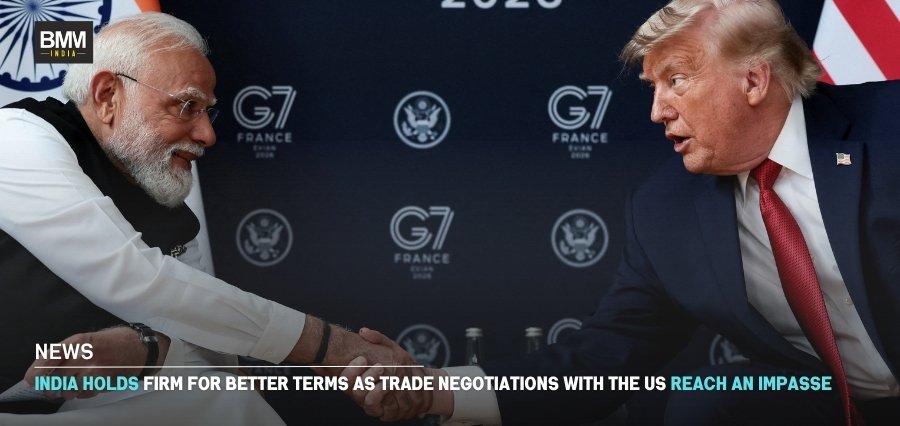
India has adopted a more assertive position in trade negotiations with the United States, choosing to hold out for favourable terms rather than rush into an interim agreement. Despite months of discussions and expectations that a limited pact was within reach, the two countries were unable to finalize an agreement during recent negotiations in New Delhi.
The proposed India-US trade deal remains stalled as key differences continue to shape discussions. India is seeking assurances that its exporters will receive a tariff advantage over major competitors, including China, while also seeking protection against the possibility of additional US levies after an agreement is reached.
New Delhi has also maintained firm boundaries around politically sensitive sectors, particularly agriculture. The government appears unwilling to make concessions that could negatively affect farmers and small businesses, which remain central to India’s domestic economy.
Stronger Economic Position Expands India’s Leverage
The confidence levels of India during negotiations have been boosted due to increasing exports and trade relations, as well as reduced economic pressures. In the months of April-June, the total export of goods in India rose by about 15% when compared to the previous year.
Trade with important markets has also remained strong. India’s exports to Gulf countries recovered significantly, while shipments to the United States increased during April and May. These developments have strengthened New Delhi’s position in the India-US trade deal negotiations by reducing pressure to accept an agreement primarily for immediate tariff relief.
India is also working on increasing their access to other important markets as well. They have signed a free trade agreement with the UK, which is set to be operational in the coming month, and have one planned with the European Union that will come into being in early 2027.
Tariff Risks Continue to Create Uncertainty
Although India has gained greater negotiating leverage, delaying the India-US trade deal is not without risk. A large proportion of Indian goods currently entering the United States faces a 10% tariff, and the US administration is expected to introduce steeper duties on selected imports later this month.
The US has already proposed tariffs up to 12.5% for some nations including India, owing to claims related to trade involving goods associated with forced labour. Moreover, there could be more consequences due to American investigations regarding excess industrial capacity, which have been denied by New Delhi.
Increased tariffs would affect the competitiveness of Indian goods and increase uncertainties for firms working in both regions. But it seems that India believes that accepting unfavorable conditions for the long term will cost more than dealing with short-term tariffs.
Election Commission Rejects Claims
The Bengal Chief Election Officer, Manoj Kumar Agarwal, rejected Banerjee’s claims as “baseless.” The BJP leadership also came out in strong defense of the election procedure, arguing that the results represented the will of the people.
In response to Banerjee’s accusations, Suvendu Adhikari stressed that the election was carried out as per the constitution.
As the issue of Mamata Banerjee’s defeat continued to grow, constitutional law scholars started analyzing the implications of her reluctance to resign from office.
Agriculture Remains a Critical Red Line
Agriculture continues to be one of the most sensitive areas in the India-US trade deal discussions. The agricultural sector in India has been protected in the past for its significance to the economy as a whole. Opening up the sector to more foreign competition might pose economic and political problems.
Consequently, the Indian authorities have made it clear that they will not allow their core interests to be compromised in order to move faster with the negotiation process.
This is also informed by the need to protect small businesses and the domestic industries. Instead of focusing solely on lowering the tariffs, India seems to be assessing the overall impact of the deal on employment and production.
Economic Stability Reduces the Urgency to Compromise
Low oil prices and a more favorable economic environment have given India more flexibility when negotiating. According to Goldman Sachs, India’s projected GDP growth rate for 2026 has been revised upwards to 6.8% by the bank amid lower projections for inflation and current account deficit. The weaker rupee position has also made Indian exports more competitive.
These developments have lowered the importance of the agreement, thus enabling India’s negotiators to concentrate on achieving better results in the future. India could be taking into consideration the uncertainty regarding new US trade policies. This is in view of the opposition to these plans by several US attorneys general in various states.
Negotiations Continue Despite Major Differences
Since both sides are actively involved in talks, it is safe to say that no failure has occurred in the process yet. Officials from the United States are confident that there will be an agreement one day despite the fact that there was no timeline presented regarding this issue.
The fate of India-US trade deal largely depends on whether both sides can strike a balance between their interests. The United States strives to obtain more benefits, while India aims to receive real tariff benefits and protecting strategically important domestic industries.
Currently, the strategy of India shows a certain tendency related to its new stance on the global trade arena. The country is ready to bargain thanks to growth in exports, foreign alliances, and an improved economy.
Although the delay of India-US trade deal causes uncertainty, the capital of India believes that obtaining a balanced and sustainable deal is more significant than achieving an agreement soon.
Also Read :-West Bengal Exit Poll 2026 Signals Tight Battle After High Voter Turnout