
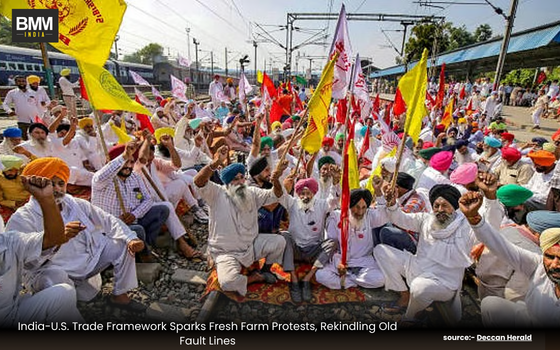
India’s newly announced India-U.S. trade framework has quickly turned into a political and social flashpoint, with farm unions and opposition parties warning that it could severely harm the country’s already fragile agricultural sector. Nationwide protests have been called, reviving memories of the massive 2020–21 farm law agitation that forced the government to repeal three controversial agricultural reforms. While the government insists that farmers’ interests remain safeguarded, critics argue that the India-U.S. trade framework risks exposing Indian farmers to unfair competition from heavily subsidised American agriculture.
Government Assurances and Market Access Promises
The government has defended the trade agreement between India and the US by pointing out that rice, wheat, corn, and dairy products are not included in the list of goods that can be imported at a lower cost. Officials say that this protection keeps India’s food supply safe and protects small farmers from price shocks. At the same time, they talk about new export opportunities, saying that Indian farmers who grow basmati rice, fruits, spices, coffee, and tea would be able to sell their goods in the U.S. without paying any taxes. The government says that the India-U.S. trade framework could help farmers sell more products and make more money by connecting them to global value chains.
Farmers Flag Structural Inequalities
But farm groups are still not convinced. Rakesh Tikait said, “We are worried about the India-U.S. trade deal because it would hurt Indian farmers, who are much more vulnerable than American farmers.” He said that U.S. farmers usually work on much larger plots of land and get much more money from the government. Indian farmers, on the other hand, have to deal with rising costs of growing crops, crop losses due to climate change, and weak processing infrastructure. Critics say that the India-U.S. trade framework could make things very hard for Indian producers if these structural gaps aren’t fixed.
Call for Protests and Stronger Transparency
People from areas with a lot of horticulture have also spoken out against it. The Kashmir Valley Fruit Growers-cum-Dealers Union has said that bringing apples in from the U.S. could destroy jobs in important apple-growing states. The group told Narendra Modi that more than 700,000 families depend on horticulture and asked for import duties on U.S. apples that are more than 100%. For these farmers, the India-U.S. trade framework is not just about trade policy; it’s also about staying alive in a market that is getting more and more competitive.
Apple Growers and Regional Fears
People from areas with a lot of horticulture have also spoken out against it. The Kashmir Valley Fruit Growers-cum-Dealers Union has said that bringing apples in from the U.S. could destroy jobs in important apple-growing states. The group told Narendra Modi that more than 700,000 families depend on horticulture and asked for import duties on U.S. apples that are more than 100%. For these farmers, the India-U.S. trade framework is not just about trade policy; it’s also about staying alive in a market that is getting more and more competitive.
Political Battle Lines Harden
The Indian National Congress, which is the opposition party, has called the India-U.S. trade framework a “total surrender” of national and farm interests. They want to know why detailed product lists and tariff lines haven’t been made public. Pawan Khera, a leader in Congress, said that India could become a dumping ground for U.S. agricultural products. He pointed to comments by Brooke Rollins, who said that the deal would increase American farm exports to India and bring money into rural America. Farmer leaders are still calling for full transparency, saying that without it, the India-U.S. trade framework could make policymakers and farmers even more suspicious of each other.
As the debates get more heated, the way people react to the India-U.S. trade framework may not only affect India’s trade policy but also the political landscape in the future, especially in rural India, where memories of past protests are still fresh.
Also Read :- India and Malaysia Deepen Strategic Engagement as Modi and Anwar Reaffirm Comprehensive Partnership