
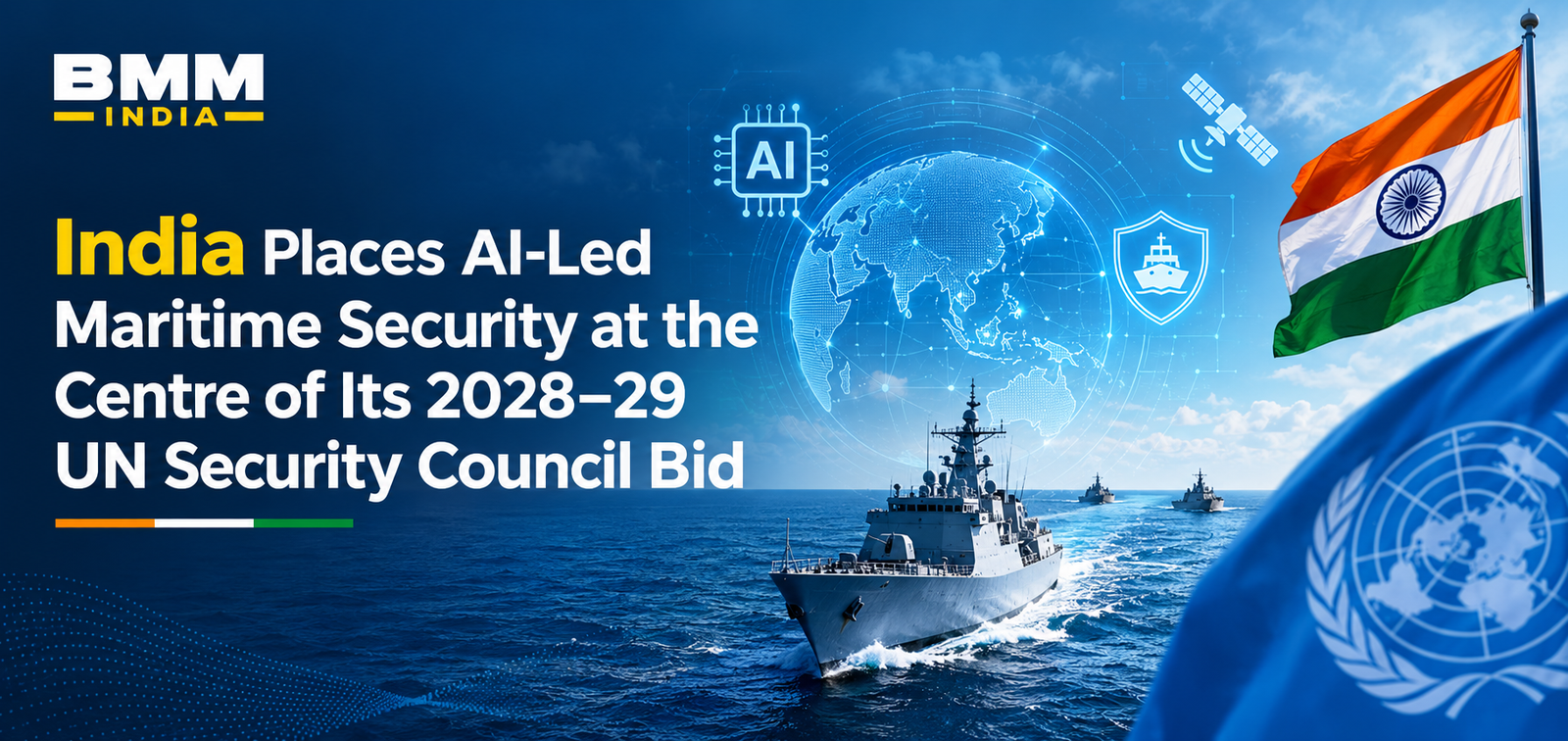
India has identified artificial intelligence and maritime security as two major priorities in its campaign for a non-permanent seat on the United Nations Security Council (UNSC) for the 2028–29 term. The country is positioning technological innovation, safer international waterways and stronger global cooperation as key elements of its diplomatic agenda, highlighting the growing importance of emerging technologies in addressing threats to international peace and stability.
AI and Maritime Security Shape India’s UNSC Agenda
Permanent Representative of India to the United Nations, Harish Parvathaneni, mentioned some of the concerns related to technology and maritime security in a high-level debate in the Security Council on Emerging Technologies and Maritime Security: Implications for Peace and Security. The Indian representative stated that advances in technology should improve the level of human security, opportunities, and safety in the maritime sphere, but not increase inequality.
“Technology must enhance human security, not jeopardize it; technology must enhance opportunity, not widen inequalities; and technology must enhance the safety of the shared maritime commons, not turn it into a contested space,” Parvathaneni said.
Also, he noted the need to provide developing countries with access to advanced technologies and expertise. As per the envoy, involvement of different countries in the technological process is critical to ensuring the benefits of technological innovation.
AI to Strengthen Maritime Surveillance and Safety
For India, it is believed that AI can be of great help in boosting maritime security by enhancing surveillance, detecting suspicious actions and responding to threats. According to Parvathaneni, it is important to consider the possible benefits from the use of AI tools in analysing satellite images, radar information and vessels data to enhance maritime domain awareness.
All this can help in monitoring ships, detecting abnormal activity and handling emergencies at the sea. The use of advanced technologies can assist in search-and-rescue operations and in coordinating work of different nations ensuring security of international maritime zones.
India offers to exchange experiences and cooperate under the Information Fusion Centre–Indian Ocean Region (IFC-IOR). This centre shows how information sharing and cooperation between states can help in maritime security through better coordination and awareness.
This strategy of India is based on its SAGAR vision, which is an abbreviation for Security and Growth for All in the Region.
Protecting Global Trade Routes Against Emerging Threats
He also raised concerns about the increasing challenges to commercial ships and trade routes. Attacks on commercial ships are now showing how even disruptions at strategically vital maritime bottlenecks can have repercussions on economies outside the geographical area of the attacks.
Parvathaneni once again condemned attacks on commercial ships and called for the need to ensure the safety of navigation, maritime trade, and seafarers according to international law.
These attacks put the lives of maritime employees at risk, cause disruptions in supply chains and create economic uncertainty, especially in developing nations where the burden is much greater due to higher transport costs.
The discussions came in the backdrop of reports from the Iranian Navy saying that three oil tankers in the Strait of Hormuz were hit by sea mines and set ablaze.
Addressing Cybersecurity Risks and Technological Misuse
While acknowledging the advantages offered by new technologies, India pointed out that there are dangers associated with greater digitalization and automation of its maritime infrastructure.
The port facilities, ships, communication infrastructure and undersea infrastructure have been getting more vulnerable to the threats of cyberspace. Increasing use of autonomous systems creates issues relating to accountability, attribution and unintended escalation.
Parvathaneni emphasized the need for having appropriate safety measures, human involvement and proper assignment of responsibilities in relation to the utilization of such new technologies. It is equally important to ensure that the principles of UN Charter and international laws like UNCLOS govern state behavior.
India Prepares for the 2028–29 Security Council Election
India is up for a seat in the UNSC that will be valid for two years, starting from 2028. The election for this position will take place in June 2027, where India and Tajikistan will be vying for one seat each in the Asia-Pacific Group.
By focusing on artificial intelligence and maritime security as part of its agenda, India is trying to make an effort towards helping shape the global dialogue regarding technological governance and securing shipping lanes and security collectively.