
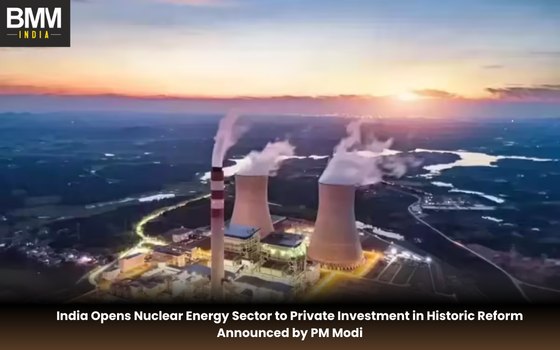
Source:- ET Government
On November 27, Prime Minister Narendra Modi announced one of India’s biggest energy reforms in decades in the Nuclear Energy Sector the country will allow private investment in its tightly controlled nuclear power sector. He called it a “historic shift” and said that the move will open the door to new ideas, improve India’s long-term energy security, and make India a global leader in advanced nuclear technologies.
The announcement was made at the opening of Skyroot Aerospace’s new Infinity Campus in Hyderabad. Modi also showed off the Vikram-I rocket, which is India’s first privately built satellite-launch vehicle. The setting was symbolic of how private companies changed India’s space industry, and Modi wants to do the same thing in the nuclear sector.
Big Change for India’s Energy Future
Modi said, “India is opening the Nuclear Energy Sector to private players for the first time.” “This will make small modular reactors, advanced reactors, and nuclear innovations more likely to happen.” His statement is a clear break from the Atomic Energy Act of 1962, which gave the central government full control over nuclear power generation and put the whole sector under the Department of Atomic Energy (DAE).
India’s Nuclear Energy Sector has long been marked by centralized control, a lack of transparency, and slow growth because it needs a lot of money and technology to grow. The government wants to make things more efficient, speed up timelines, and bring in new technological capabilities that state institutions have had trouble delivering on a large scale by allowing private investment.
Modi said that the reform is similar to the opening of the space sector, where companies like Skyroot have become major innovators since the government relaxed rules. “The range of reforms is always getting bigger. “India is now moving toward opening the nuclear sector, just like the private sector was allowed to work on space innovation,” he said.
Bharat Small Reactors, India’s version of the fast-growing category of small modular reactors (SMRs), are a big part of the new plan. People all over the world think that SMRs are the future of nuclear energy because they are small, cheap, safe, and can be used for a variety of energy needs.
India needs these next-generation systems because it needs clean energy all the time to support its growing industries and cut down on its reliance on fossil fuels. Modi said that getting private companies involved would speed up the rollout of SMRs and advanced reactors by a lot. This would help India build a modern, flexible, and diverse energy ecosystem.
He said, “This reform will make India’s energy security and technological leadership stronger.” He also said that India’s growing demand for electricity, which is driven by manufacturing growth, digital infrastructure, and urban expansion, needs stable baseload power that works with solar, wind, and hydro energy.
Push for Legislation through the Atomic Energy Bill, 2025
The time of the announcement is very important. It comes just a few days before the Winter Session of Parliament, when the government will present the Atomic Energy Bill, 2025. The Bill is expected to update rules and regulations, change the way private companies can participate, and change how safety, liability, and technology licensing work.
This is in line with what the DAE said before. The department confirmed in August that the government wants to change both the Atomic Energy Act of 1962 and the Civil Liability for Nuclear Damage (CLND) Act of 2010 so that private companies can get involved. The CLND Act, in particular, has been seen as a major barrier for both foreign and domestic private businesses because it has strict rules about supplier liability.
Allowing private companies to get involved, whether through joint ventures, independent reactor development, or technology partnerships, would bring in money as well as global expertise, advanced manufacturing skills, and competitive efficiencies.
A Turning Point in India’s Nuclear Energy History
Modi’s announcement is the most daring attempt yet to change India’s nuclear energy landscape, which has been tightly controlled, slow-moving, and mostly off-limits to private business for a long time. The government wants to build a stronger, cleaner, and more technologically advanced energy future by letting private companies get involved.
If done right, the changes could bring about a new era in which nuclear power with Nuclear Energy Sector is not only a strategic asset but also a competitive driver of innovation, industrial growth, and sustainability in the years to come.
Also Read : Business Minds Media India for more information