
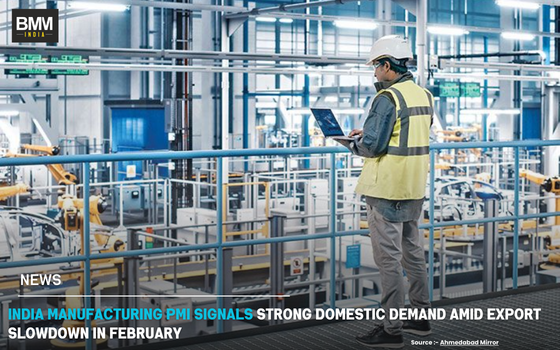
India’s factory activity accelerated in February, with the India Manufacturing PMI pointing to its fastest expansion in four months. Driven by robust domestic demand, new orders and production levels climbed steadily, reinforcing expectations that Asia’s third-largest economy will remain resilient in the current quarter despite global trade uncertainties.
The most recent data shows that India’s growth momentum is still going strong after a strong quarter from October to December, when the economy grew by 7.8% thanks to a 13.3% increase in manufacturing output. India is expected to grow by 7.6% for the fiscal year ending in March, which shows that it is one of the world’s fastest-growing major economies.
India Manufacturing PMI Rises to Four-Month High
According to the India Manufacturing PMI, compiled by S&P Global and released by HSBC, the index rose to 56.9 in February from 55.4 in January. Although the figure fell slightly short of the preliminary estimate of 57.5, it remained comfortably above the 50 mark that separates expansion from contraction.
The rise in the India Manufacturing PMI shows that production is picking up and domestic orders are getting stronger. For the second month in a row, production grew at a faster rate, thanks to improvements in efficiency, investments in technology, and strong local demand.
According to Pranjul Bhandari, Chief India Economist at HSBC, the final reading for February showed that manufacturing activity was picking up speed, mostly because of strong domestic orders. But she warned that demand from outside the country is still falling, which makes things harder for manufacturers who export.
Export Orders Weaken Despite Tariff Relief
While domestic indicators got stronger, new export orders grew at their slowest rate in 17 months. Even though the U.S. cut tariffs on Indian goods from 50% to 18%, this slowdown still happened. The survey took place between February 9 and February 23, after the tariffs were lowered but before U.S. President Donald Trump announced new global tariffs after the Supreme Court ruled on some levies.
The slowing growth of exports suggests that there is still uncertainty in global trade. Changes in U.S. tariff policy and rising tensions around the world have kept demand from abroad low. Because of this, manufacturing sectors that rely on exports are still cautious, which limits hiring and capacity growth.
Domestic Orders Power Growth
A key highlight of the India Manufacturing PMI survey was the sharp rise in new domestic orders, which grew at their fastest pace since October. This surge indicates that local consumption and business investment remain healthy, helping to offset weaker external demand.
The amount of goods produced also went up at the fastest rate in four months. Companies said that this growth was due to better operational efficiency, steady consumer demand, and ongoing technology upgrades. The data shows that India’s internal market is still protecting it from global volatility.
Inflation, Pricing, and Employment Trends
The cost of inputs stayed moderate and didn’t change from January. But manufacturers raised prices the fastest in four months. Companies were able to pass on higher costs to customers without hurting sales volumes too much because there was a lot of demand.
There were more jobs available than there had been in the previous four months, but hiring was still slow. Only about 4% of the companies that were surveyed said they were hiring more people. Most companies kept the same number of employees. The small increase in jobs shows that businesses are still being careful because they don’t know what’s going to happen with exports.
Outlook: Confidence Remains Firm
Despite slower export growth, business confidence improved to a four-month high. Manufacturers expressed optimism about production prospects over the coming year, driven by expectations of sustained domestic demand and continued investment in efficiency-enhancing technologies.
The India Manufacturing PMI therefore paints a mixed but largely positive picture: strong domestic fundamentals counterbalancing softer global demand. As long as internal consumption and investment remain robust, India’s manufacturing sector appears well-positioned to maintain steady growth.
Overall, February’s data underscores the resilience of India’s economy. While external risks persist, the strength reflected in the India Manufacturing PMI suggests that domestic demand continues to provide a solid foundation for sustained expansion in the months ahead.
Also Read :- Mark Carney India Visit Signals Trade Reset and Strategic Realignment