
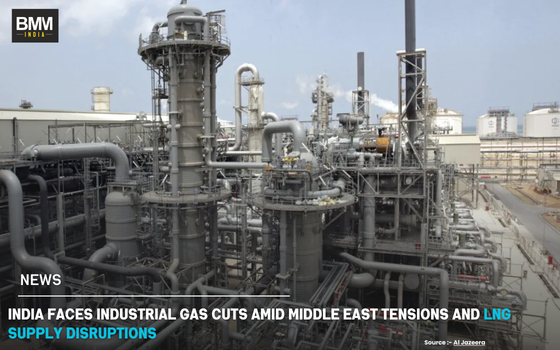
India’s industrial sector is getting less natural gas because major energy companies said they would cut back on supplies after problems in the Middle East. The situation happened when Qatar, which is one of the biggest exporters of liquefied natural gas in the world, stopped making it because of rising geopolitical tensions in the Gulf region. The news has raised worries about India LNG supply crisis, which could have an impact on businesses that rely on natural gas.
India LNG Supply Crisis: Industries Brace for Gas Supply Cuts
Major Indian energy companies began notifying customers about reduced gas availability late Monday. Companies including Petronet LNG Ltd, GAIL (India), and Indian Oil Corporation informed industrial users that natural gas deliveries would be reduced due to a drop in liquefied natural gas imports.
The cuts are expected to be between 10 and 30 percent, depending on what contracts say and what is available. Industry sources say that suppliers have set minimum lifting quantities for deliveries. This is a way to avoid penalties for breaking contracts while dealing with lower supply volumes.
The problems started when Qatar stopped making liquefied natural gas on Monday. The move came after Iran kept firing missiles at Gulf countries in response to military actions by Israel and the United States. These rising tensions have made shipping routes across the region very difficult.
The Strait of Hormuz, which is an important shipping route for energy around the world, has also been affected. Reports say that oil and gas shipments through the strait have slowed down or stopped completely. This has led to higher shipping and energy prices around the world.
As a result, India is experiencing what analysts describe as an emerging India LNG supply crisis, particularly for industries that rely heavily on imported liquefied natural gas.
India’s Heavy Dependence on Middle Eastern LNG
India is the fourth largest importer of liquefied natural gas in the world right now, and it gets a lot of its supplies from the Middle East. The country has strong trade ties in energy with big producers like Qatar and the United Arab Emirates.
India is the second biggest buyer of Qatari LNG and the Abu Dhabi National Oil Company is the biggest buyer of LNG from India. Because of this reliance, any problems in the Gulf region quickly lead to problems with the supply of energy in India.
Sources who know about the situation say that Petronet LNG has already told GAIL and other downstream distributors that there will be less LNG cargo available. These supply problems are now affecting businesses all over the country.
The situation highlights the growing vulnerability of India’s energy system during periods of geopolitical instability, reinforcing concerns around the ongoing India LNG supply crisis.
Companies Explore Spot Purchases to Bridge Supply Gap
Indian energy companies are now planning to buy LNG through spot market tenders to make up for the shortage. Indian Oil Corporation, GAIL, and Petronet LNG are some of the companies that are likely to issue emergency tenders to get more cargo.
However, buying LNG on the spot may be expensive. Prices on the spot market have gone up a lot because of problems with supply and rising geopolitical risks in the Gulf region.
Freight and insurance costs have also gone up, along with fuel prices. Shipping companies are charging more because they are worried about security along major energy transit routes like the Strait of Hormuz.
Energy analysts say that if tensions continue, the India LNG supply crisis could deepen, forcing industries to pay higher prices for natural gas or switch to alternative fuels.
Industrial Sector Likely to Feel the Impact
Some of the largest consumers of natural gas in India are fertilizers, petrochemicals, power generation, and manufacturing. Any long term scarcity may shift the production timelines or increase the cost of conducting business.
The government and energy corporations are attempting to identify alternative energy supplies, yet, the existing issues demonstrate that risky worldwide energy chains can be.
Should Middle East tensions continue and shipping routes become more unstable the India LNG supply crisis may not be limited to a temporary reduction of supply and start to impact the overall economic activity in the country. Firms and policy makers are observing the state of affairs closely in the meantime and seeking means to stabilize the supplies and reduce the impact on the industrial sector in India.
Also Read :-India Manufacturing PMI Signals Strong Domestic Demand Amid Export Slowdown in February