
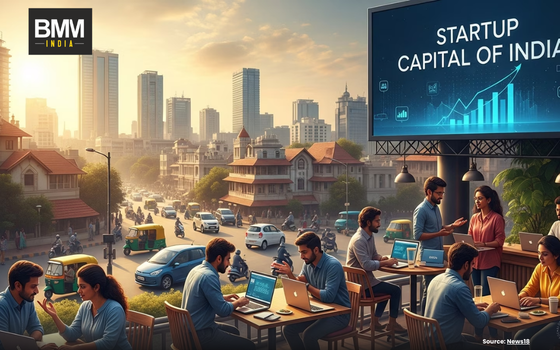
India is undergoing a remarkable entrepreneurial transformation. Once viewed primarily as a services-driven economy, the country is now emerging as one of the most influential Global Startup Capitals hubs in the world. With a surge in innovation, supportive policy frameworks, expanding digital infrastructure, and a young, ambitious workforce, India is steadily positioning itself as the global startup capital. At the heart of this shift lies the rapid evolution of the Indian startup ecosystem, which has matured in both scale and sophistication.
A Shift from Volume to Value
In the beginning of the startup boom in India as Global Startup Capital, companies were formed quickly and used aggressive growth strategies. The ecosystem has changed over time, though. Today’s founders care more about making money, being environmentally friendly, and creating long-term value. This change shows that the Indian startup ecosystem is becoming more mature. Companies are being built on stronger foundations, with a better understanding of the market, and with disciplined execution. Startups aren’t just trying to get high valuations anymore; they’re also coming up with scalable solutions to real problems.
Demographic and Digital Advantage
India’s demographic profile gives it a unique edge. With one of the world’s youngest populations and a fast-growing middle class, the country offers an enormous consumer base eager to adopt new technologies. Combined with widespread smartphone usage and affordable internet access, startups can now reach millions of users rapidly. This digital penetration has been a major catalyst for innovation, strengthening the Indian startupecosystem across both urban and semi-urban regions.
The growth of Tier-2 and Tier-3 cities as places where startups can get help is just as important. Entrepreneurs are coming from smaller towns, and they bring with them cost savings, knowledge of the area, and different points of view. This decentralization is making the ecosystem stronger and more open to everyone.
Government as an Enabler, not just a Regulator
One of the most important things that has helped India’s Global Startup Capital grow is the government’s active role. Policies have changed from being focused on control to being focused on helping over the past ten years. Entrepreneurs have less trouble because the process of starting a business is easier, there are tax breaks, there are ways to recognize startups, and it is easier to protect intellectual property.
More importantly, public-sector initiatives now actively encourage innovation. From funding support and credit guarantees to mentorship platforms and procurement access, the government has helped institutionalise entrepreneurship. This policy scaffolding has provided stability and confidence, allowing the Indian startup ecosystem to grow with reduced regulatory uncertainty.
Global Startup Capital is Smarter and more Patient
During the global liquidity boom, India saw a lot of venture capital come in. Now, though, the funding environment is more selective and strategic. Investors today are putting money into founders who have clear ways to make money and business models that can be defended. Domestic capital, family offices, corporate venture arms, and institutional investors have become more important, which means that companies don’t have to rely as much on outside funding cycles.
This evolution has strengthened the Indian startup ecosystem by encouraging founders to think long-term. Capital is no longer just fuel for expansion; it is a partner in governance, strategy, and sustainable growth.
Emerging Sectors Driving the Next Wave
The story of India’s startups is no longer just about e-commerce and consumer apps. Several important sectors are now making the ecosystem important around the world.
Fintech is still doing well because more and more people are using digital technology and getting access to financial services. Deep tech and AI startups are making products for markets all over the world, but especially in healthcare, manufacturing, and logistics. As sustainability becomes more important, climate tech and agritech are becoming more popular. At the same time, healthtech and edtech are using India’s size to offer cheap, tech-enabled services.
These sectors are pushing the Indian startup ecosystem beyond replication models and into original innovation.
Talent, Learning, and Founder Maturity
Another important driver is human capital. India makes a lot of engineers, designers, and managers every year. A lot of them now choose to start their own businesses instead of working for someone else. Founder experience is also improving. Entrepreneurs who have done it before bring operational knowledge, global experience, and better ways of running a business.
This growing depth of leadership is reinforcing the Indian startup ecosystem, making it more credible to global partners and investors.
Challenges Remain, but Momentum is Strong
Even though it has made progress, the ecosystem still has problems. Regulatory clarity in some areas, fierce competition for top talent, and gaps in infrastructure in some areas need to be addressed on an ongoing basis. But more and more, startups, policymakers, and private institutions are working together to solve these problems.
India is different because it can learn and change quickly. The ecosystem has shown that it can bounce back from global downturns and market corrections, coming back stronger and more focused each time.
Conclusion: India as a Startup Destination
India’s rise as a Global Startup Capital hub is not due to one thing, but to a combination of intent, policy, talent, and opportunity. The Indian startup scene has gone from trying things out to doing things, from copying to coming up with new ideas. India is no longer just a part of the global innovation economy; it is shaping it as startups continue to solve problems at home and around the world.
India is more than just a market for entrepreneurs, investors, and innovators around the world. It is a movement. And that movement is only getting stronger.
Also Read :- Business Minds Media India For More information