
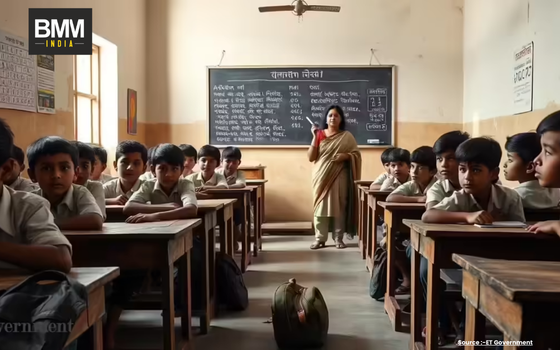
India’s education system is undergoing one of the most significant transformations in its history. Long centered on rote learning, standardized examinations, and rigid academic pathways, it is now being reshaped to meet the demands of a rapidly evolving economy. The Future of Education in India is no longer confined to traditional classrooms or degree-based outcomes. Instead, it is increasingly focused on skills, adaptability, and lifelong learning.
At the heart of this transition lie three powerful forces: the National Education Policy 2020, the rapid rise of EdTech, and a growing emphasis on employability.
Moving Beyond Rote Learning
For a long time, the Indian school system put more value on memorization than on understanding. This method produced a lot of graduates, but they often didn’t learn how to think critically, solve problems, or do things in the real world. Employers often said there was a difference between what students learned in school and what they needed to know to get a job.
The Future of Education in India marks a decisive shift away from this model. Learning is increasingly being designed around application, creativity, and conceptual clarity rather than exam performance alone. This shift recognizes that knowledge is no longer scarce; the ability to apply it meaningfully is.
NEP 2020 as a Structural Reset
The National Education Policy 2020 is a major change to India’s education system. It gives students more freedom in choosing their subjects, encourages learning across multiple subjects, and stresses basic reading and writing skills at an early age.
One of the most transformative aspects of NEP 2020 is its focus on skills and competencies. By integrating vocational education, coding, and experiential learning from the school level onwards, the policy aligns education more closely with real-world needs. The Future of Education in India under NEP 2020 envisions learners who can think across disciplines rather than being locked into narrow academic silos.
The policy also promotes multiple exit options in higher education, recognizing that learning journeys are not linear. This flexibility reduces dropout stigma and encourages lifelong engagement with education.
The Rise of Skill-Based Learning
Skill-based learning is emerging as a cornerstone of The Future of Education in India. Employers today value skills such as communication, digital literacy, adaptability, and collaboration as much as, if not more than, formal degrees.
More and more people are getting interested in industry-specific certification programs, apprenticeships, and micro-credentials. These models help students learn specific skills quickly and keep them up to date as industries change. Skill-based programs are different from traditional degrees in that they are modular, focus on outcomes, and are often designed with input from industry.
This method also makes opportunities available to everyone. People from different backgrounds can learn skills that will help them get jobs without having to pay for long, expensive degree programs.
EdTech as an Enabler, Not a Replacement
The fast growth of EdTech has been very important in making things more accessible and personalized. Online platforms, AI-powered learning tools, and hybrid models have made education more open and adaptable.
However, The Future of Education in India is not about replacing teachers with technology. Instead, EdTech acts as an enabler, supporting educators with data-driven insights, adaptive content, and scalable delivery models. Teachers remain central as mentors, facilitators, and guides.
EdTech also helps break down geographic and socioeconomic barriers by reaching students in remote and underserved areas. Recorded lessons, virtual labs, and interactive platforms help fill in the gaps that regular systems have trouble with.
Employability as the New Benchmark
Employability has become an important measure of how well you do in school. Having a degree alone doesn’t mean you’ll get a job. Employers are more and more looking at candidates’ practical skills, ability to learn quickly, and ability to solve problems.
The Future of Education in India places employability at the center of curriculum design. Internships, project-based learning, industry collaborations, and real-world problem-solving are becoming integral parts of education pathways.
Institutions that align closely with industry needs and continuously update curricula will play a critical role in reducing the skills mismatch that currently affects many graduates.
The Role of Teachers and Institutions
The job of teachers is changing as education changes. Teachers are changing from people who give out information to people who help students learn. To help with this change, professionals need to get training in digital skills and learn about how things are done in the industry.
Institutions also need to change how they are set up. We need to get rid of rigid hierarchies and old-fashioned ways of testing and replace them with more flexible, learner-centered models. India’s future in education depends on more than just policy and technology. It also needs to change the way schools work.
Challenges on the Path Forward
Even though there is hope, there are still big problems to solve. There are still problems with the digital divide, the uneven implementation of NEP 2020, teacher readiness, and quality control in EdTech. It is also important to make sure that skill-based education doesn’t become broken or shallow.
To solve these problems and make sure everyone gets a fair outcome, policy alignment, public-private partnerships, and ongoing investment will be very important.
A Holistic Vision for the Future
Ultimately, The Future of Education in India is about creating a system that empowers learners to thrive in uncertainty. It is not about choosing between academics and skills, or classrooms and technology. It is about integration.
India has the chance to create an education system that is open to everyone, adaptable, and ready for the future by bringing together policy changes, new technologies, and learning that focuses on getting people jobs. The success of this change will have an impact on the country’s economy and society for decades to come, as well as on people’s careers.
Also Read :- Business Minds Media India For More information