
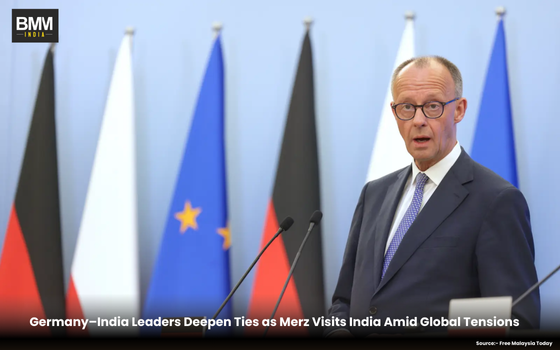
Germany’s new chancellor, Friedrich Merz, arrived in India for a high-profile two-day visit that signals a decisive strengthening of the Germany India strategic partnership at a time of growing global uncertainty and shifting geopolitical alignments. The visit, which included a symbolic stop at Mahatma Gandhi’s ashram, set the tone for a deeper alignment between two democracies seeking stability, economic resilience, and security in a rapidly fragmenting world order.
Friedrich Merz, reflected on the moral and historical bond between the two nations, stating that Gandhi’s legacy continues to unite Indians and Germans as friends at a time when his teachings are needed more than ever. Beyond symbolism, however, the visit is firmly rooted in economic and strategic interests, reinforcing the expanding Germany India strategic partnership.
Friedrich Merz Shared Response to Global Economic Pressures
The visit comes at a time when relations with the US are tense because President Donald Trump has threatened to annex Greenland and raise tariffs, which has made allies and partners nervous. India currently has one of the highest US tariff rates at 50%. Europe is also becoming more unsure about trade and security ties across the Atlantic.
Against this backdrop, Germany and India are positioning their relationship as a pillar of stability within the Germany India strategic partnership framework. During Friedrich Merz,’s visit, the two sides are expected to sign agreements covering business cooperation, semiconductor development, defense projects, and access to critical minerals. Germany, in particular, is keen to reduce its dependence on China for rare earths and other raw materials, making India a crucial alternative supplier within the Germany India strategic partnership.
Technology, Minerals, and Workforce Mobility
A memorandum of understanding on critical minerals is one of the most important things that has happened. It is a key part of the growing strategic partnership between Germany and India. Germany’s industrial future depends on these minerals for electric cars, renewable energy, and advanced electronics.
At the same time, both governments are expected to reach an agreement that will make it easier for Indian doctors and nurses to work in Germany.
This initiative strengthens the people-to-people aspect of the Germany-India strategic partnership while giving skilled Indian workers access to European markets. This is important because Germany’s economy is growing slowly because there aren’t enough workers.
Friedrich Merz is with a powerful group of German business leaders, including the CEOs of Siemens, DHL Group, Infineon Technologies, Uniper, and Airbus Defence and Space. There are also senior executives from Boehringer Ingelheim and ThyssenKrupp Marine Systems there, which shows how interested companies are in the strategic partnership between Germany and India in manufacturing, pharmaceuticals, and defense.
Defense and Industrial Cooperation
A deal to make submarines worth more than $8 billion is at the heart of the talks. This could be India’s biggest defense contract ever. This project would be a historic step forward in the strategic partnership between Germany and India. It would include German defense technology in India’s long-term plans to modernize its navy and give Germany a bigger role in the security architecture of the Indo-Pacific.
The two countries are also working together more in the areas of semiconductors and pharmaceuticals, which are important for the stability of the global supply chain. The goal of these projects is to protect both economies from geopolitical shocks, which strengthens the economic pillar of the Germany-India strategic partnership.
Trade and the EU-India Free Trade Agreement
Friedrich Merz, is also likely to tell Prime Minister Narendra Modi to speed up talks between India and the EU on a free trade agreement that has been a long time coming. Discussions have come to a standstill over things like steel and cars, but both sides are in a hurry to reach an agreement before EU President Ursula von der Leyen visits India later this month.
A successful FTA would further institutionalize the Germany India strategic partnership within a broader Europe–India economic framework.
A Growing Economic Alliance
Germany needs India as a partner in the Indo-Pacific because it is the G20’s fastest-growing economy. More than 700 Indian companies invest in Germany, and more than 2,000 German companies do business in India. Germany is India’s biggest trading partner in the European Union, with trade between the two countries reaching nearly $50 billion. This shows how strong the Germany-India strategic partnership is.
On his second day, Friedrich Merz, went to a Bosch factory in Bangalore. This shows the industrial backbone of this relationship and how innovation, manufacturing, and investment are becoming more and more connected.
The Germany-India strategic partnership is becoming one of the most important bilateral relationships that will shape trade, technology, and security in the 21st century as global alliances change and old certainties fade.
Also Read :- India-US Trade Deal Stalls Amid Diplomatic and Tariff Tensions