
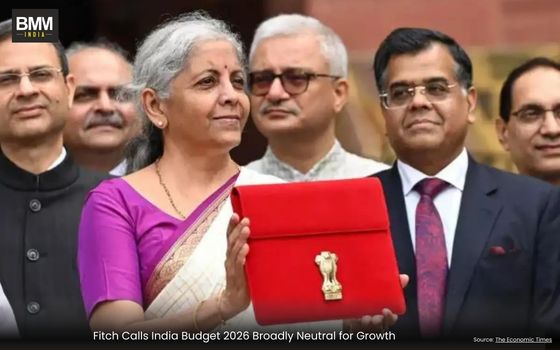
Global ratings agency Fitch Ratings has described the India Budget 2026 as “broadly neutral” for economic growth, while cautioning that the pace of fiscal consolidation is slowing as deficit reduction becomes more challenging without affecting expansion momentum. The assessment came after the Union government outlined its fiscal roadmap for the 2026/27 financial year.
According to Fitch, the budget balances growth support with fiscal discipline, but highlights the structural difficulty of narrowing deficits further while sustaining strong GDP performance in the world’s fifth-largest economy.
Fiscal Targets Signal Gradual Consolidation
In the India Budget 2026, Finance Minister Nirmala Sitharaman announced a fiscal deficit target of 4.3% of GDP for FY2026/27, alongside a debt-to-GDP ratio of 55.6%. These targets reflect the government’s intent to continue consolidation, albeit at a slower pace than in recent years.
Fitch said that the moderation fits with its belief that cutting the deficit too quickly could hurt economic growth. The agency said, “It is getting harder to make more progress on reducing the deficit without hurting GDP growth.” They also said that India’s approach is still practical in a world that is changing quickly.
Capital Spending Improves Quality of Finances
Fitch said that the quality of government finances had gotten a lot better, even though deficits were still higher than they were before the pandemic. The agency said that higher deficits today are mostly due to higher capital spending, not uncontrolled revenue spending.
“The revenue deficit is narrower than pre-pandemic levels, even after including previously off-budget spending,” Fitch stated. This suggests that the India Budget 2026 is prioritizing long-term productive investments, particularly in infrastructure and manufacturing capacity, rather than short-term consumption.
Such spending, Fitch noted, supports medium-term growth prospects even as headline fiscal metrics remain elevated.
Ratings Agencies Maintain Cautious Optimism
Both Fitch and Moody’s Ratings noted that India’s fiscal record is getting better, but they also pointed out that its deficits and debt are still higher than those of other sovereign countries. Fitch gives India a BBB- rating, and Moody’s gives it a Baa3 rating.
S&P Global Ratings raised India’s rating to BBB in 2025. This was the first time in 18 years that the country had a higher sovereign rating. That upgrade was based on stronger growth, more momentum for reform, and more trust in institutions.
Fitch did say, though, that general government debt, deficits, and interest payments are only slowly going down and are still major barriers to further rating improvements.
Growth Outlook Remains Resilient
The Indian government thinks that the economy will grow by 6.8% to 7.2% in the fiscal year that starts on April 1. Fitch agreed with this optimism, saying that the India Budget 2026 is unlikely to have a big effect on growth in either direction.
Fitch said, “Strong GDP growth is driving positive momentum in several of India’s sovereign credit metrics.” If this growth keeps up, it could slowly improve India’s credit rating, even though the country is still having trouble with its finances.
Reform Momentum Key to Private Investment
Fitch stressed the need to build on recent structural reforms in order to attract more private investment in the future. Progress in manufacturing, infrastructure, and stable policies could boost productivity and help growth in the long term.
In that context, the India Budget 2026 reflects a careful balancing act, maintaining fiscal credibility while ensuring growth remains resilient amid global uncertainty. While consolidation may be slowing, ratings agencies agree that India’s broader economic trajectory remains positive, provided reform momentum continues.
Also Read :- Business Minds Media India for more information