
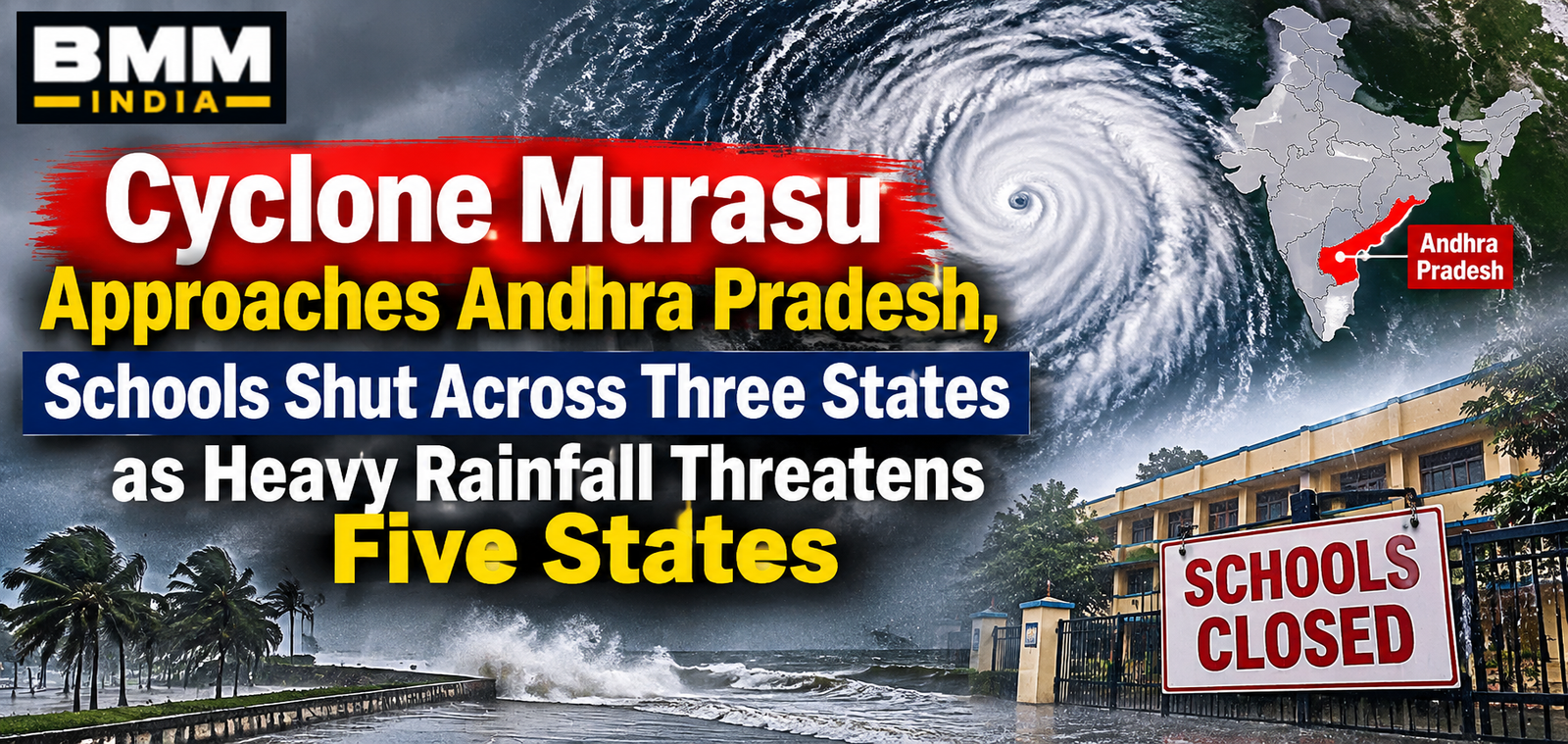
A fresh cyclone threat has prompted widespread precautionary measures across eastern and southern India, with authorities preparing for severe weather conditions as Cyclone Murasu advances towards the Andhra Pradesh coastline. The India Meteorological Department (IMD) has forecast a landfall between Nellore and Narsapur, near Ongole, between late November 2 and the early hours of November 3. With wind speeds expected to reach 110 kmph and gusts touching 120 kmph, several state administrations have intensified emergency arrangements, while educational institutions in vulnerable districts have been ordered to remain closed.
Cyclone Murasu Intensifies Over the Bay of Bengal
According to the IMD report, the weather system developed as a very distinct low-pressure system over the south-east Bay of Bengal and adjoining areas of the Andaman Sea.
It further grew stronger and transformed into a depression on October 31 and later turned into a deep depression on November 1.
The weather system was further upgraded into a cyclonic storm at 11:30 AM on November 1 and then developed further into a severe cyclonic storm on November 2.
According to the bulletin of November 2, the IMD identified Cyclone Murasu about 260 kilometres east-northeast of Chennai, 290 kilometres east-southeast of Nellore, and 330 kilometres southeast of Ongole. The weather system will head north-westwards before making landfall over the southern Andhra Pradesh coast.
Five States Face Heavy Rainfall Warnings
Rainfall is anticipated to occur widely in Andhra Pradesh, Tamil Nadu, Telangana, Odisha and Chhattisgarh regions. In addition, heavy rain or even very heavy rainfall is expected in some locations.
Heavy to very heavy rainfall is expected in Coastal Andhra Pradesh. However, some isolated places can experience very heavy rainfall on November 2 and 3. In addition, Tamil Nadu experiences weather warnings especially in Chennai and Tiruvallur where heavy to very heavy rainfall is predicted.
For Telangana region, rainfall activities are expected to continue from November 2 to 4. Orange warnings have been given for Khammam, Nalgonda, Suryapet, Mahabubnagar, Nagarkurnool and Wanaparthy while several other districts have been issued yellow alerts. Southern part of Odisha will experience heavy rainfall and may experience intense rainfall on November 3 and 4. Southern Chhattisgarh will experience heavy to very heavy rainfall.
Schools and Colleges Closed in Three States
Amongst the precautionary measures taken by the administrations of the affected areas, one is that schools and colleges have been ordered to be shut down.
In Tamil Nadu, schools and colleges in the districts of Chennai and Tiruvallur have been ordered to be shut down on November 2. Likewise, schools and colleges in NTR, Palnadu, Nellore and Gudur districts of Andhra Pradesh have also been ordered to be closed.
Furthermore, the administration of Malkangiri district of Odisha has also ordered the closure of schools and colleges from November 2 to 4. Some educational institutions in Andhra Pradesh might be used as temporary shelter places for the cyclone.
Authorities Strengthen Emergency Preparedness
With the possibility of the effect extending beyond multiple states, the agencies responsible for managing disasters and the state administrations have geared up with better preparations.
The officials in the state of Andhra Pradesh have been asked to ensure proper man-power, equipment and supplies in places where the effect is expected. Odisha too has been preparing for any eventuality, especially in the south districts where the effect of the cyclone Arnab was felt recently.
The IMD has requested fishermen not to go to affected parts of the Bay of Bengal and also along the coast of Andhra Pradesh, North Tamil Nadu and Puducherry. People residing in coastal areas have been asked to adhere to the advisories issued by the authorities.
Cyclone Expected to Weaken After Landfall
While Cyclone Murasu will still have severe cyclonic storm status when making landfall, weather forecasts state that it will lose strength gradually.
Cyclone Murasu will weaken to a cyclonic storm category early in the morning of November 3, when it will be carrying winds at 80-90 kmph with gusts at 100 kmph. It is expected that the Cyclone will weaken to a deep depression category towards late November 3, followed by weakening to a depression category by November 4.
Nevertheless, while the weakening in the wind strength may offer some relief, rainfall activity is anticipated to continue in several states affected.