
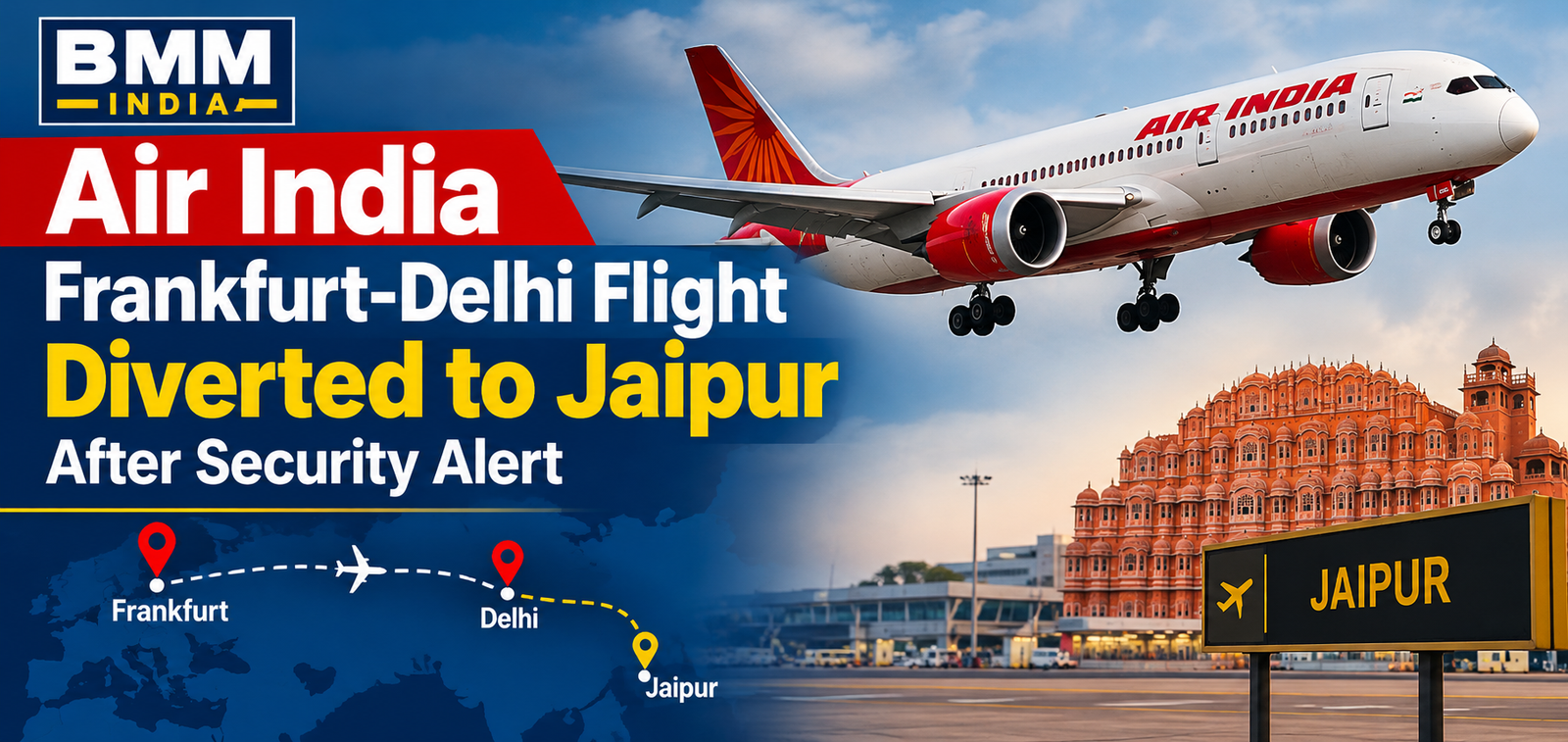
An Air India flight travelling from Frankfurt, Germany, to New Delhi was diverted to Jaipur on Wednesday, October 14, following a security alert that prompted an emergency landing and extensive safety checks. The incident triggered a response from airport authorities, police and security agencies, who began inspecting the aircraft after it landed safely at Jaipur International Airport.
The aircraft, operating as flight AI2030, was a Boeing 787-9 Dreamliner. According to a report by The Times of India, citing sources from the Press Trust of India (PTI), the aircraft was moved to an isolation bay after landing to facilitate security procedures.
The Air India flight diverted to Jaipur was met by security personnel as authorities worked to establish the circumstances behind the alert. Initial reports described a possible bomb threat, while the precise nature of the incident remained under investigation.
Pilot Reportedly Activates Hijack Alert Code
Initial information showed that the pilot set off Squawk Code 7500 when the plane was flying within the Mumbai Flight Information Region. This is a transponder code recognized globally and indicates hijacking or unlawful interference.
The activation of this code led to the diversion of the aircraft from its destination, which was Delhi, and it was directed to Jaipur instead. This was done as a measure to coordinate between the air traffic control department and the security forces in order to facilitate the landing of the plane and the inspection of the plane.
Nevertheless, the activation of this code cannot, on its own, prove that there was a hijack. There is a need to find out the reason behind the sending of the message and whether there was any danger involved at all.
Security Agencies Begin Aircraft Inspection
After the Air India flight diverted to Jaipur, airport authorities alerted local police about the emergency landing. The Assistant Commissioner of Police Shiv Dayal said that the plane was being examined by the security personnel in the isolation bay, reported The Times of India.
The ground staff of ATS, airport security agencies, and police sealed the area and put the safety protocols into action. The NSG forces were also put on alert in New Delhi, the report added.
The passengers and crew members were de-boarded in shifts under the security arrangement. The baggage of the passengers was also screened for the security measures.
Another report from The Indian Express said that all the 306 passengers were able to land safely in Jaipur airport and were escorted to the terminal in the supervision of the security agencies.
Investigation Underway as Details Remain Unclear
The exact circumstances that led to the Air India flight diverted to Jaipur were not immediately established. Initial news stories indicated a potential bomb threat, but other news sources stated that this was actually a suspected hijack alert.
As reported in The Indian Express, there were some initial signs which indicated that the hijack alert could have been a false alert. But this point had not been fully clarified and the investigation was still on.
This is an important difference because an alert does not equate to a threat and therefore the circumstances related to this alert need to be analyzed and the information verified.
More information was expected regarding the source of the alert, the results of the aircraft inspection, and the further operations of the airline.
Renewed Attention on Aviation Security
The Air India flight diverted to Jaipur incident highlights the procedures followed when an aircraft encounters a potential security threat. Diversions, communications with air traffic control and inspection are preventive measures which will help in safeguarding passengers, crew and airport staff.
International aviation uses standardized emergency communication procedures to help pilots and air traffic controllers deal with emergencies. Squawk Code 7500 is a code that indicates illegal interference; therefore, its use is always a matter of concern.
It is important to note that in any case where an emergency situation occurs, it is very necessary to gather enough facts and then make decisions. While early information can help one understand the response to the emergency, the cause of a security breach can only be known by doing some more verification.
In this particular situation, the main emphasis in the ongoing investigation is on security assessment and how to handle the alert and move forward safely. The diversion of Air India flight to Jaipur shows that precaution is the first step in all aviation safety protocols.