
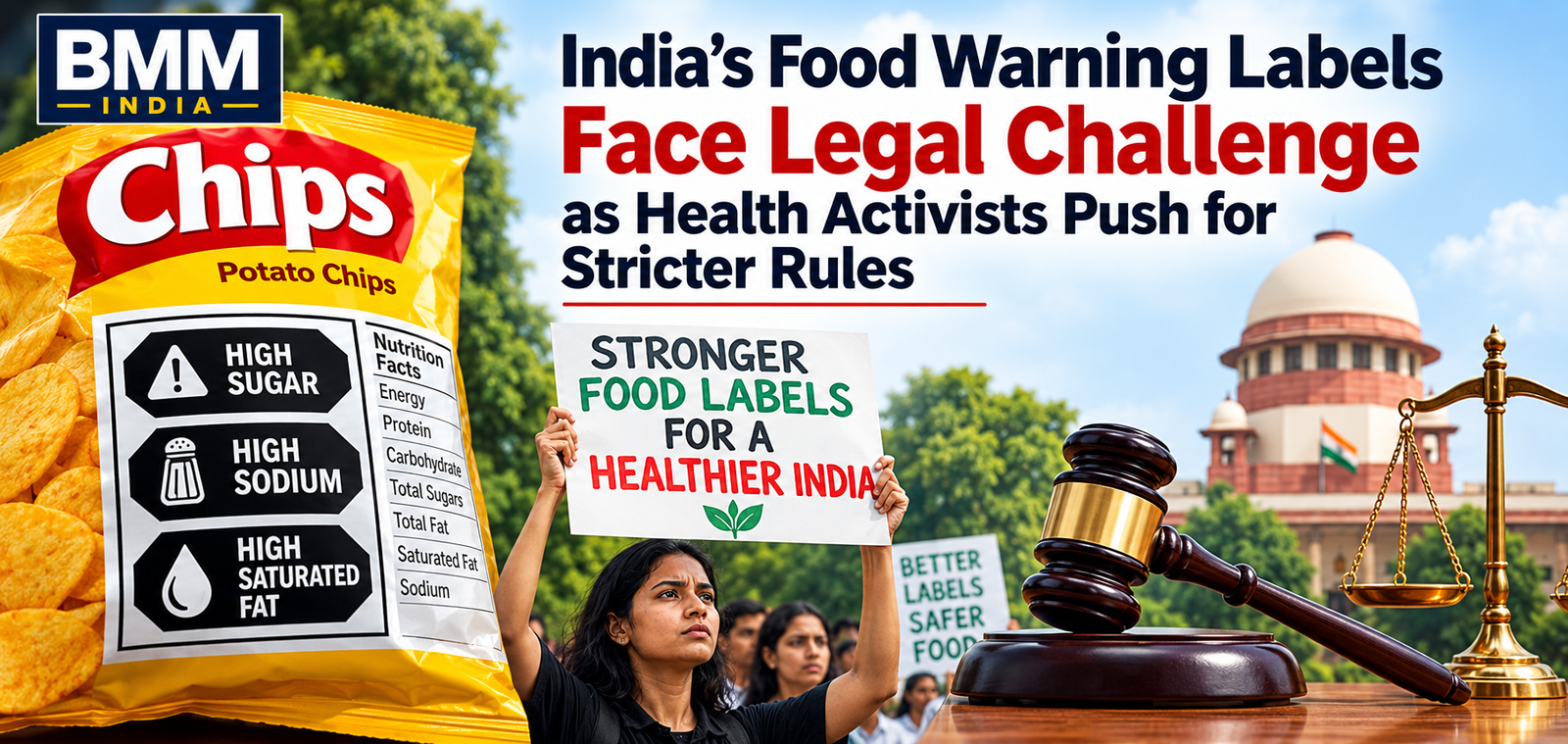
India’s ongoing debate over food warning labels in India has entered a new phase after public health activists approached the Supreme Court, arguing that the government’s proposed labeling framework is too lenient and could fail to adequately protect consumers from unhealthy packaged foods. The legal challenge has intensified discussions around nutrition transparency, public health, and the role of food manufacturers in a rapidly growing packaged food market.
Health Activists Take the Matter to Court
A nonprofit health advocacy group has filed concerns before the Supreme Court against the Food Safety and Standards Authority of India’s (FSSAI) proposed front-of-pack labeling rules. The petition marks the first formal legal challenge to the government’s latest proposal on food warning labels in India.
With the latest proposal, the warning sign will be placed only if there are at least two of the three main nutrients added sugar, salt, or saturated fat, that have reached the prescribed limit. The activists feel that the limit allows unhealthy products a way out of placing any warning sign because of a high quantity of only one ingredient.
Why the Proposed Rules Are Being Questioned
According to the health professionals who support the petition, any consumer should be provided with adequate information regarding products containing too much sugar, too much salt, or too many saturated fats, even if one of these exceeds recommended levels. The petitioners argue that the current recommendation may compromise the role of food warning labels in India.
This controversy arises at a time when there are growing fears of obesity and other lifestyle diseases. Public health experts believe that proper labeling will assist consumers in making wise purchases.
Industry Raises Concerns Too
It is worth noting that criticism against the policy does not come only from health activists. Some food and beverage firms are also opposed to the policy, albeit with varying justifications. The industry claims that the thresholds set by the policy are stringent enough to make warning signs appear on many products.
What we have here is a strange scenario in which both health activists and industry players are opposed to the same policy, but for entirely different reasons.
Rising Focus on Public Health
Food warning labels in India have become an issue at a time when regulatory authorities are paying more attention to food safety issues in the country. The increased inspections and fines recently have drawn attention to problems connected to labeling, food quality, and nutritional information. Regulators have also experienced additional pressure in regard to consumer protection and meeting global standards.
In its ruling, the Supreme Court has repeatedly pointed to the necessity of front-of-pack warnings amid the prevalence of childhood obesity and consumption of ultra-processed foods. The experts refer to examples from other countries, such as the Chilean warning label system, in which visible nutritional warnings helped decrease the consumption of unhealthy foods.
What Happens Next?
This case would be closely watched by policy makers, healthcare professionals and industry officials alike, since the Supreme Court is expected to review this case. The final decision can determine the future of food warning labels in India and the way that nutrition information would be provided for millions of consumers.
While striving to maintain the right balance between the priority of public health concerns and needs of the industry, this case demonstrates how important it has become to provide clear labeling of food products in a country where more and more people suffer from diet-related diseases.