
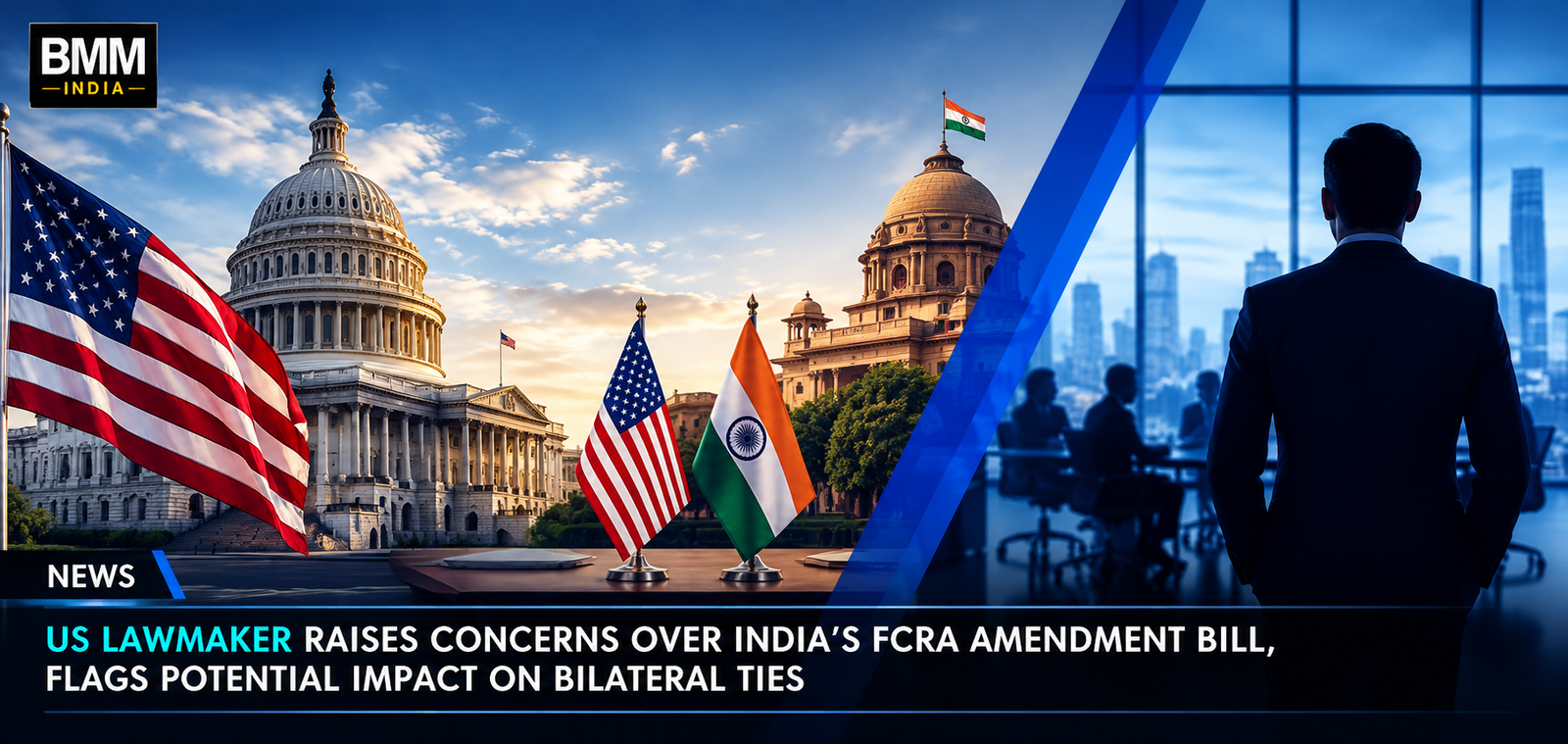
A fresh diplomatic debate has emerged after US Congressman Riley Moore criticized India’s proposed FCRA Amendment Bill, describing it as “a clear attack against Christians” and warning that its passage could become a point of concern in India-US relations. The Republican lawmaker from West Virginia argued that the proposed amendments could allow the Indian government to assume control of churches and religious charities under certain circumstances, an allegation that has intensified international attention on the legislation.
Moore shared his concerns through a public statement on social media, emphasizing Christianity’s long history in India before questioning the proposed legal changes. He stated that if the legislation proceeds in its present form, it could affect the broader bilateral relationship between New Delhi and Washington.
What the FCRA Amendment Bill Proposes
The FCRA Amendment Bill seeks to modify India’s existing Foreign Contribution (Regulation) Act, which governs how non-governmental organizations, trusts, educational institutions, and religious bodies receive and utilize foreign funding.
One of the major suggestions included in the Bill is the establishment of a Designated Authority. The Designated Authority, once appointed by the government, will have the responsibility of managing any foreign contributions as well as any property developed through foreign contributions in case the registration of any organization under FCRA gets terminated, withdrawn voluntarily, or expires because of non-renewal.
Other administrative changes suggested in the Bill include a change in the eligibility criteria for renewal of registrations, a time limit for utilizing the foreign contributions, limitations on transferring the foreign contributions between different registered organizations, and lowering the maximum sentence from five years to one year for some offenses.
Why the Proposal Has Become Controversial
The FCRA Amendment Bill has generated considerable debate among lawmakers, religious organizations, and civil society groups.
It is being said that empowering the Designated Authority with the power of administering foreign-fund assets will provide more scope for government regulation of such institutions which depend on international funding. According to Congressman Moore, the Bill is a direct threat to Christian organizations and may affect diplomacy between India and the U.S.
However, within the country itself, there has been opposition from various political parties and regional organizations against the amendments. There are reports that various organizations in states where Christians constitute a sizeable number have raised apprehensions about the effect of the Bill on churches, educational institutions, charities, and NGOs working with foreign funds.
Government’s Broader Regulatory Objectives
The suggested changes are part of an initiative to strengthen the regulatory regime for foreign contributions.
As per the information provided with the bill, more than ₹55,700 crore in foreign contributions have come to registered organizations in the period 2019 to 2022. Till 15th July 2026, India had 14,449 FCRA registrations, with more than 22,000 registrations being cancelled and more than 15,000 registrations expiring. The intention of these reforms is to set up better administrative machinery to take care of assets and foreign contributions once the registration is no longer valid. The proponents of these changes feel that such oversight will help increase accountability and improve transparency in the administration of foreign-funded organizations. But the opponents feel that the extra powers need to be protected by some additional measures
Potential Implications for India-US Relations
While it is true that the remarks do not constitute the policy of the United States but of one particular congressman of the country, nonetheless, they bring to the table of debate an international angle.
The relationship between India and the US is a strategic partnership, covering many aspects of defense, technology, business, and regional security. Any bill that raises some serious concerns for the influential lawmakers of the United States can well get into the larger context of religious freedom, civil society, and democracy. However, even if the bill in question does not immediately change any form of the bilateral relationship, it cannot be ruled out of this larger context. Whether this FCRA Amendment Bill would affect diplomacy or not would largely depend on the bill itself and how both the governments react to it.
Also Read : –Delimitation in India: The Political Storm Behind the Women’s Reservation Bill