
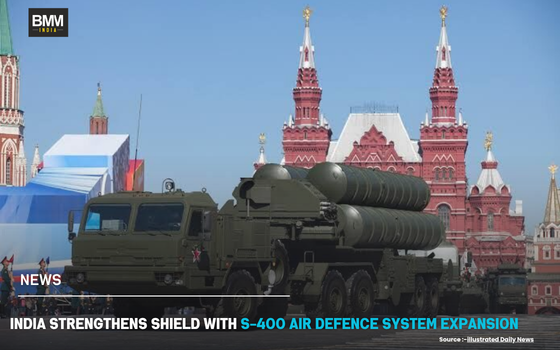
As regional security challenges continue to evolve, India is taking major steps to reinforce its aerial defence capabilities. On the eve of the anniversary of Operation Sindoor, the arrival of the fourth Russian S-400 air defence system marks another significant milestone in the country’s defence preparedness. The system is expected to reach an Indian port by mid-May, while the fifth and final unit under the current deal is scheduled for delivery in November this year.
The growing importance of the S-400 air defence system has become even more evident after its reported performance during Operation Sindoor, where it played a decisive role in neutralizing enemy aerial threats and strengthening India’s strategic deterrence posture.
Fourth S-400 System Nearing Delivery
Defence sources have confirmed that the new system was inspected by the Indian Air Force on April 18 before being shipped to India. It was sent for shipment from Russia last week and is en route to India.
This fourth S-400 air defence system will be deployed in the Rajasthan sector to boost its missile defence capability against Pakistan. This is believed to be a move to bolster defence along the western front, particularly in the aftermath of Operation Sindoor.
The fifth system, which reportedly performed remarkably well in the military exercise, is likely to be deployed in the middle sector to handle any security concerns along the China border, enabling a two-front defence capability for India.
Role of the S-400 During Operation Sindoor
The performance of the S-400 air defence system during Operation Sindoor has had a profound impact on India’s future acquisitions. According to defence experts, India deployed 11 long-range S-400 missiles during the operation, striking down Pakistani fighter aircraft, early warning and transport aircraft.
The system’s long detection and engagement range (up to 400 kilometers) provided India with a significant advantage. According to reports, Pakistan was compelled to deploy its front-line fighters and other critical aircraft in Quetta and Peshawar due to the risk of being targeted.
Pakistan also reportedly tried to take out two of India’s S-400 systems in Punjab and Gujarat, due to the threat from its radar and interception abilities. But the robust air defence ensured that these weapons remained safe and operational.
India Plans Five More S-400 Systems
The success of the system has led to the Modi government already approving the procurement of five more S-400 air defence systems. The additional systems will provide India with a substantial boost to its air defence capabilities and to eliminate threats in the air before they enter its vital areas.
The S-400 can shoot down fighter jets, drones, cruise missiles, and ballistic missiles, and is one of the most modern air defence systems on the planet. It will provide India with a deep strike capability well inside enemy territory, offering a significant deterrent and combat edge.
India has also chosen to acquire 280 short and long-range S-400 missiles to replace those used during Operation Sindoor and to build up healthy stocks for future operations.
Local Maintenance and Defence Manufacturing Push
India is also considering setting up a Maintenance, Repair, and Overhaul (MRO) unit for the S-400 air defence system through private partnerships. This would help minimise foreign repairs and increase availability.
The government is also contemplating technology transfer from Russia, which would also boost domestic defence manufacturing capabilities and the defence self-reliance agenda.
Such a base will provide for quicker turnaround and improved long-term sustainability of one of India’s most important strategic assets.
Pantsir Systems to Support S-400 Protection
India is expected to acquire at least 12 Pantsir air defence systems from Russia under a government-to-government agreement to safeguard the S-400 units, and enhance the protection against drones and loitering munitions.
Further, about 40 more Pantsir systems could be produced under the “Make in India” program. The Pantsirs will form a close-range ring of defence around the S-400 batteries, forming a multi-layered defence system
This long-distance targeting and short-range drone defence capability is part of India’s holistic approach to upgrading its defence capabilities.
Conclusion
India’s reception of the fourth S-400 air defence system and the sanctioning of five more units is indicative of its commitment to bolstering its defence capabilities. In an environment of high geopolitical tensions, these systems not only bolster military capability but also give confidence.
Through better deployment, domestic maintenance plans and other defence systems such as Pantsir, India is ensuring a more capable air defence system for the future.
Also Read :- India Bangladesh Relations Enter a New Phase with Dinesh Trivedi’s Appointment