
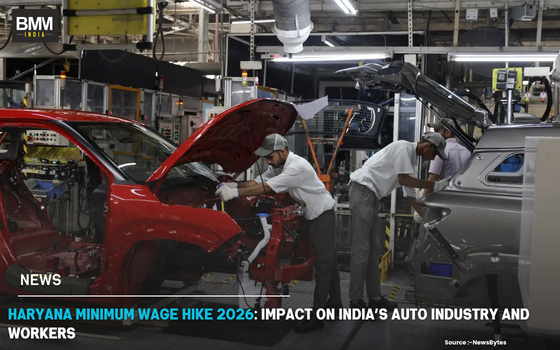
The Haryana minimum wage hike 2026 has emerged as one of the most significant labour and industrial developments in India this year. Following days of worker protests, factory boycotts, and rising living costs, the Haryana government announced a sharp 35% increase in minimum wages for unskilled workers. The move comes at a crucial time for India’s automobile manufacturing hub, especially Manesar, where major companies and suppliers operate.
What Is the Haryana Minimum Wage Hike 2026?
The Haryana minimum wage increase 2026 is an increase in the monthly wage of the unskilled employees in the state to approximately 15,220 dollars an increase in value of 11,000-12,000 dollars, which comes into effect on April 1. This upsurge came by the announcement of the protest by factory workers in Manesar and other industrial belts around it due to the escalating costs of food and living.
The move by the government is being perceived as an effort to reinstate sanity following disruption of production in a number of factories due to labour unrest.
Why Workers Protested in Manesar?
The sharp increase in the cost of living especially food price led to the protests. Employees said that local food supplied by vendors had almost doubled in cost due to disruptions in the supply chains and a current gas crisis.
The reliance of India on liquefied petroleum gas (LPG) has exposed the households and the industrial areas to the potential effects of shortages in supply. With gas being diverted to supply the household cooking demand, factories, restaurants and small businesses in industrial belts such as Manesar were crippled.
The condition of the everyday-wage workers became intolerable. A number of migrant workers were said to have gone back to their villages because the costs were rising and contributed to the labour shortages in the factories.
This increased pressure directly contributed to the Haryana minimum wage increase 2026.
Impact on India’s Auto Industry
The Haryana minimum wage hike 2026 is expected to provide relief to workers, but it also places fresh cost pressure on India’s automobile industry.
Manesar is one of India’s most importantgoogle.com/search?q=auto-manufacturing+hubs&oq=auto-manufacturing+hubs&gs_lcrp=EgZjaHJvbWUyBggAEEUYOTIICAEQABgWGB4yCAgCEAAYFhgeMggIAxAAGBYYHjIICAQQABgWGB4yDQgFEAAYhgMYgAQYigUyBwgGEAAY7wUyBwgHEAAY7wUyBwgIEAAY7wXSAQc0OTNqMGo3qAIAsAIA&sourceid=chrome&ie=UTF-8 and houses companies such as Maruti Suzuki, along with hundreds of ancillary suppliers. Production at several units, including suppliers to Hero MotoCorp and Honda, was partially disrupted during the protests.
Automakers are already dealing with:
- rising raw material costs
- supply chain disruptions
- higher energy prices
- labour shortages
With wages now significantly increased, production costs are likely to rise further. Industry analysts expect that companies may pass on these costs to consumers through vehicle price hikes.
Tata Motors and Mahindra have already increased prices, while Maruti Suzuki has indicated that a similar move may follow.
Relief for Workers
To factory workers, the Haryana minimum wage increase 2026 is a relief in financial terms in the short run.
The wage increase is likely to assist thousands of workers in coping with day-to-day needs like food, transport, and accommodation. The move was welcomed by many workers who returned to work upon announcement.
The state government has also called upon the workers to resume work peacefully to allow the normalization of industrial activities within the shortest time possible.
What Happens Next?
The Haryana minimum wage increase in 2026 can become an example to other industrial states. Indeed, similar demonstrations have already been witnessed in Noida, where workers are demanding wage equality with Haryana.
This trend has the potential to transform labour policies throughout the manufacturing industry in India in the next few months.
Short-term, the wage increase will potentially stabilize employee morale, whereas for companies, particularly automobile producers, it will be an indication of a tighter margin and even a price rise.
The Haryana minimum wage increase 2026 is not only a labour reform, but a development with far-reaching consequences both to workers and industry and to the consumers.
Also Read :- SpiceJet Ordered by UK Court to Pay $8 Million in Engine Lease Dispute