
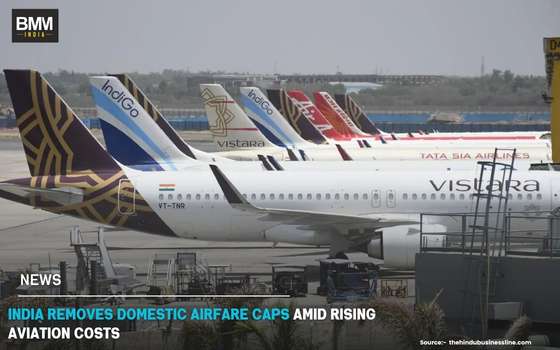
India has decided to lift its temporary Domestic Airfare Caps restrictions, marking a significant shift in the aviation sector. The move comes as airlines continue to face rising operational costs, particularly due to global geopolitical tensions and fuel price fluctuations. This development in India airfare caps removal is expected to reshape pricing strategies while balancing passenger interests and airline sustainability.
Background of India Airfare Caps Removal
The India Domestic Airfare Caps removal decision follows months of regulatory control imposed in December. These caps were introduced after widespread flight cancellations by IndiGo, which led to a surge in ticket prices across other airlines. To protect passengers from sudden fare hikes, the government stepped in to regulate pricing across different travel distances.
For instance, fares for routes under 500 kilometers were capped at 7,500 rupees, while longer routes such as Delhi to Mumbai had a ceiling of 15,000 rupees. These measures were aimed at maintaining affordability during a period of operational instability.
Reasons Behind the Policy Change
The government has now determined that the aviation sector has stabilized sufficiently to allow market-driven pricing. According to official sources, flight capacity has been restored and airline operations have returned to normal levels.
At the same time, airlines have been under increasing financial pressure. The India airfare caps removal is largely influenced by rising jet fuel prices, which have surged due to disruptions linked to the Iran conflict. Fuel costs form a major portion of airline expenses, and even a small increase can significantly impact overall budgets.
Industry analysts have highlighted that a one-dollar increase per barrel in fuel prices could raise IndiGo’s annual fuel expenses by approximately 3 billion rupees. Such cost pressures made it difficult for airlines to operate profitably under fixed fare limits.
Impact on Airlines and Industry
The removal of the Domestic Airfare Caps will be a relief to the airlines, which have been struggling with low margins. Carriers had already raised issues that capped fares were proving to be a significant source of revenue loss, particularly at a time when there was an increase in costs.
Under the new circumstances, when these restrictions are eliminated, airlines will be much more flexible in determining the price of tickets depending on the demand, the route, and operational costs. This would enhance economic health in the industry and promote additional growth and investment.
Nonetheless, the change also assigns the responsibility on the airlines to make sure that they have fair pricing. The government has ordered carriers to be transparent and they should not raise fares high that will cause harm to passengers.
What It Means for Passengers?
The India airfare caps elimination can result in more flexible pricing to the travelers. The prices of the tickets may change with the demand, season, and the popularity of the routes. Although this could lead to a rise in fares in the peak seasons, it might equally lead to competitive pricing in times of the off-peaking seasons.
The passengers are encouraged to book their flight early and observe the prices of the fares to avoid complications and buy a better price. More competition in the airline industry can also serve to keep the prices within affordable limits in spite of the lifting of the caps.
The government has stressed that fares must be reasonable and in accordance with the market situation so that the change in the policy does not impact negatively on the passengers.
Market Outlook After India Airfare Caps Removal
The aviation industry will experience a phase of adaptation after the removal of the Domestic Airfare Caps in India. Airlines will probably redefine their models of prices with an emphasis on cost management and efficiency.
The new policy would also stimulate new entrants and higher competition in the market which is ultimately beneficial both to the airlines and the consumers in the long run. The pricing environment can be more flexible which will cater to the growth of the air travel industry in India as the demand of air travel is expected to keep increasing.
Conclusion
The abolition of the Domestic Airfare Caps is a milestone to the aviation industry in the country. Although it is a godsend to airlines facing the problem of increased expenses, it also presents a new era of pricing, under market conditions.
In the near future, it will be important to balance profitability and passenger affordability. This move can be used to improve the aviation industry with proper control and good pricing policies that will not lead to loss of consumer trust.
Also Read :- India Pushes for Aadhaar App Pre-Installation on Smartphones, Faces Industry Resistance