
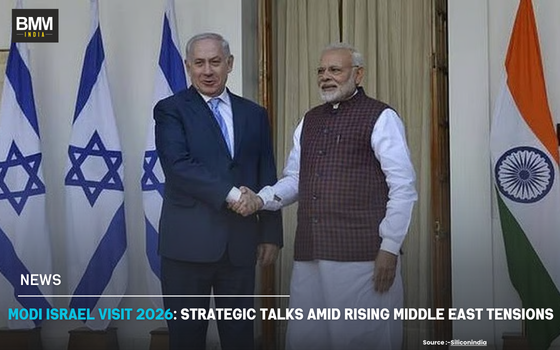
Indian Prime Minister Narendra Modi arrived in Israel on Wednesday for a two-day diplomatic engagement that both nations have framed as a defining moment in their growing strategic partnership. The Modi Israel visit comes at a time of heightened geopolitical sensitivity, with regional tensions escalating over the possibility of military confrontation between the United States and Iran.
Modi spoke to Israel’s parliament and said that India stands with Israel and offered condolences for the Hamas attack in October 2023. He stressed that India will not back down when it comes to terrorism, saying that there can be no double standards or tolerance when dealing with extremist violence. His comments brought up the common security issues that have been shaping the relationship between New Delhi and Tel Aviv more and more.
Shared Security Concerns and Political Symbolism
Benjamin Netanyahu, the Prime Minister of Israel, also spoke to the parliament. He talked about the long friendship between the two leaders. Netanyahu said that both countries are threatened by radical extremism and need to keep working together to fight terrorism.
The Modi Israel visit carries symbolic weight. Modi became the first Indian prime minister to visit Israel in 2017, marking a historic shift in diplomatic engagement. That earlier visit included widely publicized images of Modi and Netanyahu walking barefoot along a beach in Haifa, symbolizing warmth and personal camaraderie. Nearly nine years later, both leaders remain in power and continue to describe their relationship as one built on trust and shared vision.
But there was some political tension at home during the parliamentary session. A small group of opposition lawmakers walked out for a short time in protest over disagreements about how the Supreme Court should be run. This shows that there are still tensions in Israel’s political system.
Defence, AI, and Expanding Partnerships
At the heart of the Modi Israel visit are discussions expected to focus on artificial intelligence and defence collaboration. Israel, known globally for its advanced defence technologies and cybersecurity capabilities, is seeking to expand its military exports. India, one of the world’s largest defence importers, has steadily increased procurement from Israeli firms over the past decade.
Officials from both governments have said that the relationship between the two countries is about to get a lot better. A representative from the Israeli government said that the visit would open the door to new partnerships in many areas. In addition to defense, talks between the two countries are likely to focus on working together on AI, agricultural technology, water management, and innovation ecosystems.
US Military Build-Up Near Iran Raises Stakes
The timing of the Modi Israel visit adds strategic complexity. The United States has deployed substantial naval forces near Iran amid stalled negotiations over Tehran’s nuclear programme. The Pentagon has reportedly positioned an aircraft carrier in the Mediterranean, heading toward Israel’s coastline, signaling readiness amid rising tensions.
If the U.S. attacks Iran directly, Iran could strike back against Israel and U.S. military bases in Gulf Arab countries. This is especially important for India because millions of Indian citizens live and work in the Gulf region, sending billions of dollars back to India every year.
Modi admitted in his speech to Parliament that security in the Middle East is getting worse. He didn’t directly talk about Iran or the U.S. military deployment, but he did stress how important it is to talk, have stability, and have peace. He also backed American efforts to end the conflict in Gaza, saying that a full solution must include the Palestinian issue in order to bring lasting peace to the region.
Strategic Balancing in a Volatile Region
The Modi Israel visit reflects India’s broader diplomatic balancing act. New Delhi maintains strategic relations with Israel, strong economic and energy ties with Gulf Arab states, and historically cordial relations with Iran. Navigating these overlapping interests requires calibrated messaging and careful positioning.
India’s visit shows that it wants to stay active and help stabilize West Asia, even as uncertainties grow in the region. The results of Modi’s visit to Israel could affect India’s Middle East policy in the years to come, whether they are focused on defense cooperation, technological innovation, or diplomatic engagement.
Also Read :- India IT Sector Growth Crosses $300 Billion Amid AI Shift